

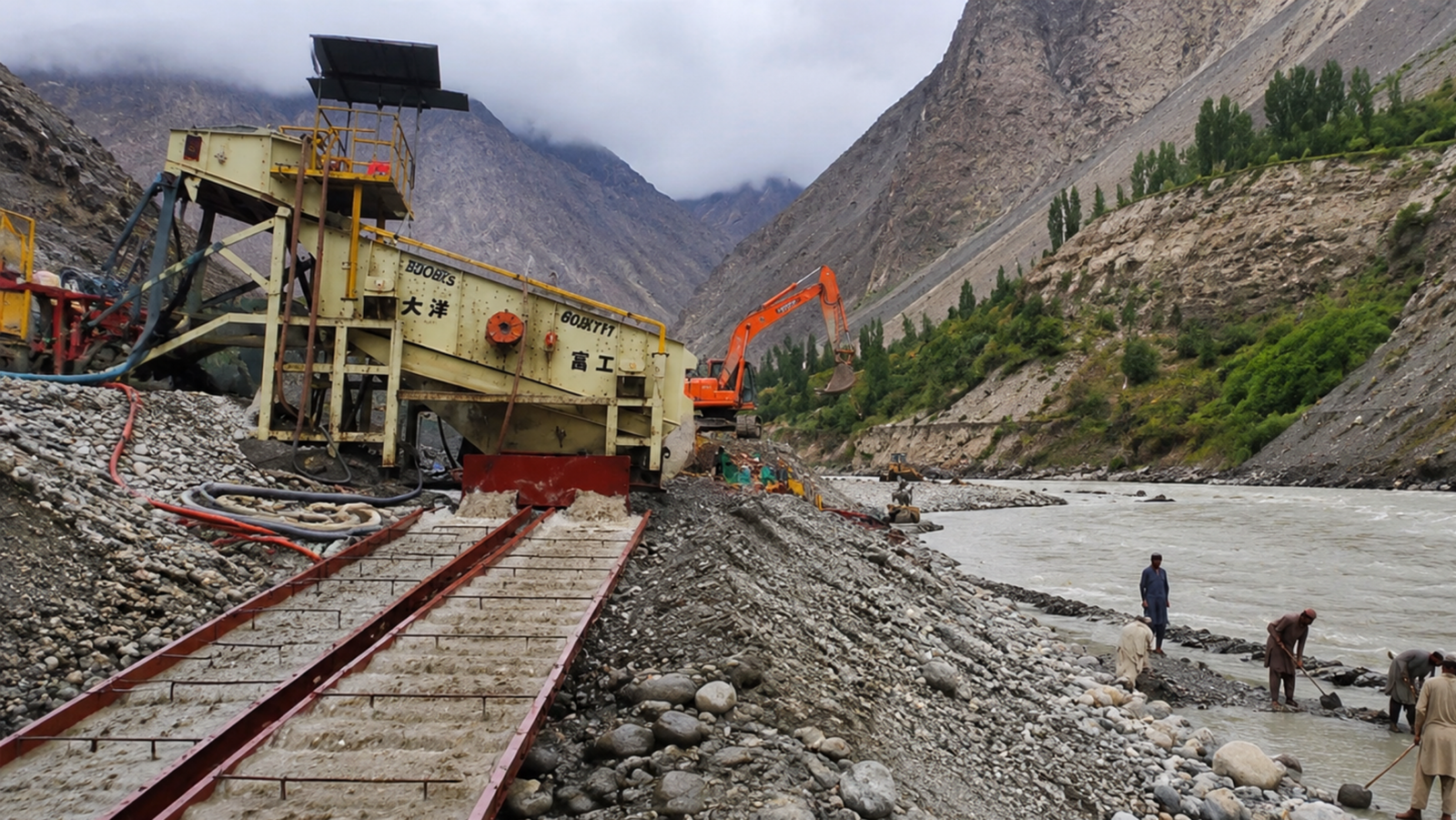
GILGIT: A rapid rise in unauthorised placer gold mining along Gilgit-Baltistan’s rivers and streams is now considered a serious threat to the region’s infrastructure — from the Diamer-Bhasha Dam to roads, bridges and villages built along the water’s edge — according to the province’s environmental regulator.
Much of the extraction work is being carried out by local firms that have teamed up with national and multinational partners under joint-venture arrangements, a business model that has become the norm across GB’s placer gold sector in recent years, according to sources familiar with the industry. Placer mining involves digging up sand and gravel from riverbeds and washing it to separate out gold, and the practice has spread quickly across the region, often outside the bounds of environmental law.
That growth has largely bypassed regulatory oversight. Officials say the mining is accelerating erosion along riverbanks, putting bridges, roads, public and private infrastructure, farmland and entire settlements at risk, while also contributing to pollution of the water, air and soil in areas where it takes place.
Khadim Hussain, director of the Gilgit-Baltistan Environmental Protection Agency (GBEPA), told Dawn that the situation has worsened in recent years as mining firms have increasingly ignored the environmental rules meant to govern their operations.
According to the agency, extraction crews are routinely deploying heavy machinery in riverbeds close to bridges, roads and other infrastructure, as well as near homes and farmland, leaving little buffer between mining activity and structures that could be damaged. Fuel and other fluids leaking from the generators and equipment used on site have also been seeping directly into the water, the GBEPA said.
Water used to wash and separate the gold is being released into rivers without first passing through any settling or filtration system, the agency found, along with untreated debris discharged alongside it. In several areas, that same contaminated water is what residents rely on for drinking and household use, according to the GBEPA.
The agency also linked riverbank protection walls, built to support mining work, and the dumping of excavated material to changes in how rivers and streams naturally flow in the area, sending water toward roads, bridges, homes, farmland and other nearby infrastructure. That kind of diversion can erode and destabilise steep slopes along the riverbanks, the agency warned, a danger that grows sharply once rivers are running high, typically when snowmelt and glacial runoff swell GB’s waterways each summer. Excavated material dumped near riverbanks, it added, risks causing lasting damage to infrastructure that cannot easily be repaired.
Site management has also drawn criticism. The GBEPA said mining crews have not set up designated camps at their project sites, and no system is in place to safely collect and dispose of the solid waste the work generates. Basic hygiene facilities were missing for workers, too, according to the agency, a gap that has left waste being handled improperly on site.
“These actions constitute a breach of the environmental conditions of approval,” the GBEPA said, warning that they also endanger public health and safety and have contributed to broader environmental degradation. That description suggests the mining operations in question already hold some form of official clearance but are failing to meet the terms attached to it.
Fine and suspension in Hunza
Regulators have already taken action against at least one operator. Following a site inspection, the GBEPA issued a notification, reviewed by Dawn, fining a placer gold mining company Rs1 million and suspending its operations over alleged breaches of environmental protection law in Nasirabad, a locality in Hunza.
The order requires the company to stop all project activity immediately. Its site has already been sealed off by the relevant authority, and the notification instructs the operator to bring itself into line with environmental law without further delay.
Such enforcement is difficult to replicate at scale, however. Hussain said neither the GBEPA nor the region’s minerals department currently has the staff needed to monitor mining activity or enforce environmental rules across the many gold-extraction sites scattered along GB’s waterways.
The environmental regulator is not alone in raising the alarm. Wapda’s Diamer-Bhasha Dam Project has separately written to the GBEPA’s director general, in a letter seen by Dawn, asking for steps to curb the sediment erosion that mining activity is causing within the dam’s project area. Left unchecked, sediment build-up of this kind can eat into a reservoir’s water-storage capacity over time, which helps explain why the project’s management flagged the issue directly to the environmental agency. According to the letter, large-scale gold extraction is under way on the Indus riverbed within the dam’s proposed reservoir zone, spanning the stretch from Basri to Raikot near Chilas in Diamer district.
In a separate letter, the executive engineer of Astore’s Communication and Works Department asked the district’s deputy commissioner to bar excavation near the Indus River bridges there.
The scale of interest in — and scrutiny of — GB’s placer gold sector is not confined to this one episode. Dawn reported in February that Kazakhstan’s Elaman Group had proposed an initial $20 million investment in placer gold exploration in the region and had already lined up a joint-venture partnership with local firms, illustrating the kind of foreign capital now flowing into the sector. Regulators elsewhere in the country have gone further, according to separate Dawn reporting: Khyber Pakhtunkhwa’s provincial government renewed a two-month prohibition on placer gold extraction from the Indus and Kabul rivers covering Swabi, Nowshera, Kohat and Karak districts, after Nowshera’s district administration dismantled illegal mining equipment at multiple sites in a raid earlier this year.
Whether the requests from Wapda and the Astore administration prompt broader restrictions on riverbed mining across Gilgit-Baltistan is not yet clear. Nor is it clear whether the GBEPA, given its acknowledged staffing shortfall, will be able to extend the kind of enforcement seen in Nasirabad to the many other extraction sites operating along the region’s rivers.











Leave a Reply