

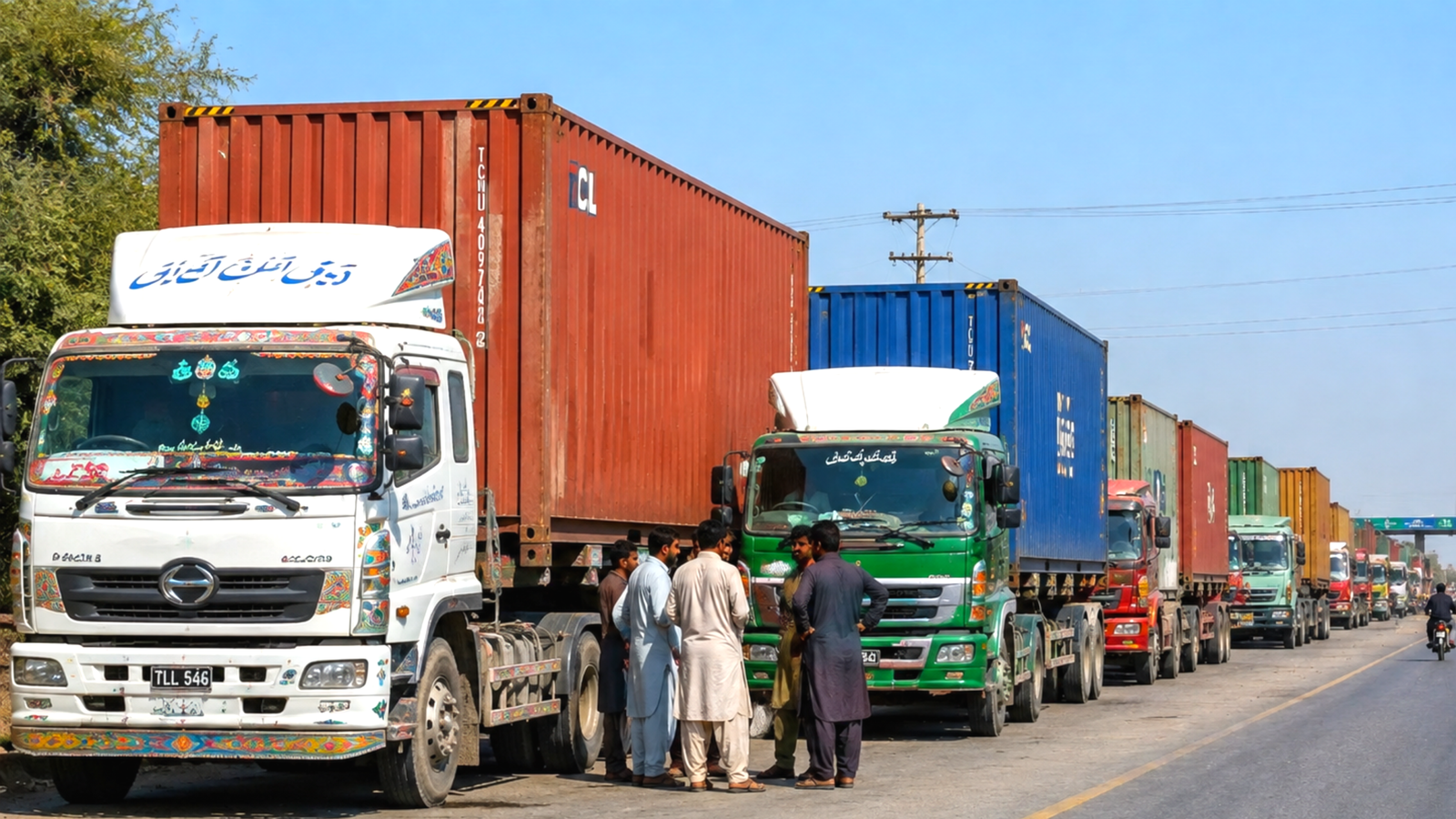
Alliance says cargo trucks, containers and oil tankers will go off the road from August 8 over fuel pricing, taxation and toll disputes with the federal government
Pakistan’s largest transport body, the All Pakistan Goods Transport Alliance, has announced an indefinite nationwide strike beginning August 8, threatening to pull cargo trucks, shipping containers and oil tankers off the country’s roads unless the federal government acts on a charter of demands covering fuel pricing, taxation and vehicle regulation.
The announcement was made at press conferences in Karachi and Islamabad in the first week of August, with transport association leaders from across the provinces endorsing the action. Alliance President Malik Shehzad Awan said transport associations nationwide had agreed to continue the strike until the government responded to demands that had already been submitted in writing to federal and provincial authorities.
A parallel announcement in Islamabad, led by All Pakistan Goods Transport Owners Association President Muhammad Owais Chaudhry Advocate alongside fellow transport leaders Malik Shafeeullah Awan and Malik Nisar, folded in Karachi’s local goods transporters, who had separately declared their own shutdown. Alliance leaders described the planned action as a peaceful “wheel-jam” strike, saying vehicles would be parked rather than used to block roads.
What the Alliance Is Demanding
The transporters’ charter of demands centers on the cost of running a commercial fleet in Pakistan, an issue that touches truck owners, dealerships supplying commercial vehicles, and financing companies carrying loans on trucks and trailers across the country.
On fuel, the alliance wants the government to scrap its daily petrol and diesel price revision mechanism and return to monthly pricing, along with a reversal of recent increases that would bring diesel back to its July 2024 level. Federal Minister for Petroleum Ali Pervaiz Malik has defended the daily-pricing system as a transparency measure intended to curb hoarding and pass on price changes immediately, and the alliance has separately demanded his resignation.
On taxation, transporters are seeking a cut in the withholding tax on cargo transport from 7 percent to 2 percent, arguing the rate should match the 2 percent already applied to oil tanker operators. They have also called for motorway toll increases to be rolled back to their mid-2024 level.
The charter additionally asks for withdrawal of a customs regulatory order, SRO 1619/2024, along with a provision in the Finance Act 2026 that allows authorities to confiscate an entire vehicle if non-duty-paid goods are found on board. Transporters want the earlier system restored, under which a vehicle is released after payment of a fine rather than seized outright.
Licensing, Axle Load and Vehicle-Age Rules
Several of the alliance’s demands bear directly on how commercial vehicles are operated and regulated. Transport leaders are asking for a simplified, properly tested process for issuing Heavy Transport Vehicle (HTV) driving licences, and for axle-load rules to be enforced uniformly, with overloading checked at factories and loading points rather than penalized on the road through fines issued to drivers.
The alliance has also rejected a policy barring vehicles older than 20 years from operating, a rule that bears on how transport companies plan fleet replacement and financing. Separately, transporters object to a requirement to pay up to Rs9.7 million in compensation in fatal road accident cases, which they say is financially unsustainable for small operators.
Security and infrastructure featured in the charter as well. The alliance called for dedicated parking facilities near Karachi Port and Port Qasim to ease congestion around container traffic, and raised concern over the burning of transport vehicles in Balochistan, asking the government to improve security along transport routes in the province.
Talks With Government Have Not Resolved the Dispute
A delegation led by Awan met Additional Inspector General of Motorway Police Javed Akbar Riaz on August 5, on the instructions of Motorway Police Inspector General Chaudhry Sultan, to discuss transporters’ complaints about fines and axle-load enforcement. Awan said afterward that the strike would go ahead as planned unless the federal and provincial governments accepted the alliance’s demands and honored assurances made in earlier rounds of talks.
The dispute has been building for weeks. In late July, Awan first warned that transporters should be prepared for a strike call “at any time,” as global crude prices climbed following renewed hostilities in the Middle East and Pakistan’s daily pricing mechanism passed the increases directly to diesel and petrol buyers. Separately, Pakistan’s petroleum levy has been constrained by conditions attached to the country’s International Monetary Fund program, limiting the government’s room to lower fuel taxes even as transporters press for relief.
Impact on Pakistan’s Commercial Vehicle and Logistics Sector
Goods transport underpins the movement of raw materials, finished goods and imported cargo between manufacturers, ports, wholesalers and retailers across Pakistan. An extended shutdown by the alliance would be expected to disrupt the delivery of industrial inputs, agricultural produce and imported goods, with knock-on effects for businesses that depend on predictable freight schedules, including auto assemblers and parts suppliers that move components and finished vehicles by road.
The dispute also highlights financial pressure within the trucking segment of Pakistan’s commercial vehicle market. Chaudhry said rising diesel prices, higher taxes and other government measures had pushed drivers, small transporters and truck owners repaying vehicle financing installments into financial difficulty, a strain that dealerships and lenders financing heavy commercial vehicles are likely to watch closely if the strike is prolonged.
This is not the first transport-sector strike Pakistan has seen this year. In June, Karachi’s public transport operators halted services for several days in a separate dispute with the Sindh government over penalties issued under the province’s electronic traffic challan system, with talks ending in deadlock before services resumed. That standoff, while distinct from the current nationwide goods transport action, reflected similar underlying tensions between transport operators and provincial authorities over fines, enforcement and operating costs.
What Happens Next
As of August 7, no resolution had been announced, and the All Pakistan Goods Transport Alliance said the strike would proceed on August 8 unless the federal and provincial governments opened substantive negotiations. Transport leaders have said the shutdown is intended to be peaceful, with vehicles kept parked rather than deployed to obstruct roads, though the scale of participation and its effect on fuel and cargo supplies nationwide will depend on how many of the alliance’s member associations join the action and how long it lasts.
The government has not publicly detailed its response to the full charter of demands. Any resolution is likely to hinge on the fuel pricing mechanism and the withholding tax rate, the two issues transport leaders have repeatedly identified as their central grievances, alongside the broader question of how Pakistan’s petroleum pricing and tax structure evolves under the country’s ongoing IMF-linked reform program.











Leave a Reply