

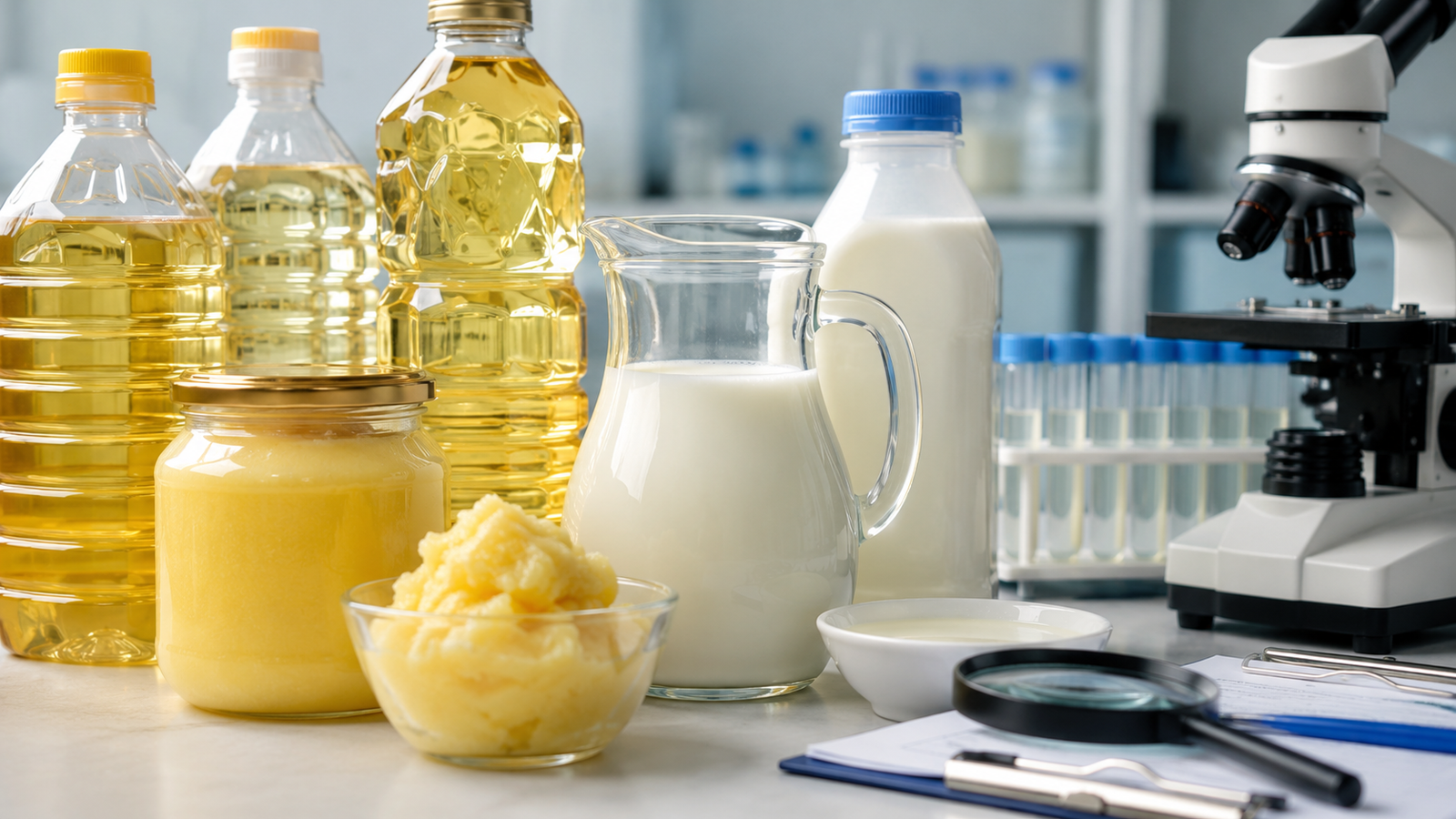
ISLAMABAD: More than a third of packaged ghee, edible oil and milk sold in Pakistani markets have failed to meet national quality standards, a government laboratory assessment presented Friday found, prompting Planning Minister Ahsan Iqbal to order a nationwide survey of loose food products sold across the country.
The findings, released by the Ministry of Planning, were based on 491 samples of packaged edible oil, ghee and milk collected from markets nationwide and tested by the Pakistan Council of Scientific and Industrial Research (PCSIR). Of the total, 315 samples conformed to prescribed national standards, while 176 — roughly 36% — were declared non-compliant.
The results were presented during a meeting of the National Price Monitoring Committee (NPMC), chaired by Federal Minister for Planning, Development and Special Initiatives Ahsan Iqbal. The testing had been carried out on the minister’s directions to scientifically evaluate the quality of some of the most widely consumed food items in Pakistani households. The consolidated report was prepared by the Pakistan Standards and Quality Control Authority (PSQCA), the body responsible for setting national product specifications, based on laboratory analysis conducted by PCSIR under the Ministry of Science and Technology.
The NPMC’s usual mandate is to track commodity price trends rather than product quality, meeting periodically to review inflation and price movements for essential goods. Its decision to take up a laboratory assessment of packaged food quality marks a notable widening of the committee’s focus, placing food safety alongside affordability on its agenda.
Ghee Recorded the Steepest Failure Rate
Among the categories tested, vanaspati ghee showed the highest rate of non-compliance. Of 204 samples examined, 98 — or 48% — failed to meet national standards, according to the report.
Blended cooking oil followed, with 40 of 146 samples, or 27%, found substandard. Packaged liquid milk was not far behind, with 26 of 104 samples, equivalent to 25%, failing the quality test.
The smaller product categories tested showed similarly uneven results. Eight of 18 milk powder samples were found non-compliant, the ministry said, while three of four refined palm oil samples and one of 13 refined canola oil samples also failed to meet the required specifications.
The report pointed to particularly severe lapses in some milk samples. In one instance, milk fat content was recorded at just 0.8%, against a minimum requirement of 3.5%, a gap the ministry cited as illustrative of the scale of quality problems present in the market.
The findings also indicated that samples from established multinational packaged milk producers met the required standards, while quality issues were concentrated among products from relatively lesser-known local brands. Neither the ministry nor the committee identified specific companies or products in the findings made public.
Nationwide Survey of Loose Products Ordered
The scale of non-compliance in packaged goods appears to have widened the scope of the government’s concern. Citing growing worries over cardiovascular disease and other non-communicable illnesses, particularly among younger Pakistanis, Iqbal directed provincial governments, regional administrations and relevant regulatory authorities to carry out a nationwide survey of loose and unpackaged edible oil, ghee and milk sold across the country.
The new survey, unlike the assessment presented to the NPMC, will look specifically at loose commodities sold outside branded packaging — a segment of the market that typically falls outside routine laboratory testing. According to the ministry, the exercise is meant to assess product quality across regions, identify the causes behind the deficiencies already found, and examine whether substandard food is contributing to public health risks.
The directive to provincial governments reflects how food-safety enforcement is structured in Pakistan. While federal bodies such as PCSIR and PSQCA set and test against national specifications, day-to-day market enforcement, including inspection of shops and unbranded goods, falls largely to provincial food authorities. A nationwide picture of loose-product quality therefore requires coordinated data collection from the provinces rather than federal testing alone.
Iqbal described food quality as a matter of national importance, saying it was the government’s responsibility to ensure citizens had access to safe and healthy food.
To follow up on the laboratory findings, the minister also constituted a specialised technical subcommittee comprising experts from the Ministry of Planning, PCSIR and PSQCA. The subcommittee has been tasked with examining the laboratory data in detail and submitting evidence-based recommendations for regulatory and policy action, a process that will shape what, if any, enforcement measures follow.
Iqbal further directed that the next phase of testing focus specifically on loose edible oil, ghee and milk, categories that were not covered under the current assessment of packaged products.
Why It Matters
Ghee, cooking oil and milk are staples of daily cooking in most Pakistani households, making the scale of non-compliance — nearly one in three samples tested — a matter of direct relevance to consumers rather than a narrow regulatory statistic. The findings point to gaps in a quality-control chain that already involves PCSIR testing, PSQCA standard-setting and provincial food authorities responsible for market enforcement.
The disclosure also lands amid heightened official attention to non-communicable diseases in Pakistan, with authorities citing rising cardiovascular disease rates, particularly among younger segments of the population, as part of the rationale for expanding the food-quality review. The report itself did not draw a direct causal link between the specific samples tested and disease trends, and the government’s stated next step is further data collection rather than any announced recall, product ban or public disclosure of non-compliant brands.
For ordinary consumers, the findings complicate the assumption that buying packaged, branded products is sufficient to guarantee food safety. With roughly a quarter to nearly half of samples failing across different categories, and no specific products named in the findings made public, shoppers currently have no way to distinguish compliant items from non-compliant ones beyond the general pattern of multinational brands testing better than lesser-known local ones.
Whether the technical subcommittee’s recommendations lead to stronger enforcement, revised standards, or public disclosure of substandard products will depend on the outcome of the review the minister has now set in motion.
ISLAMABAD: More than a third of packaged ghee, edible oil and milk sold in Pakistani markets have failed to meet national quality standards, a government laboratory assessment presented Friday found, prompting Planning Minister Ahsan Iqbal to order a nationwide survey of loose food products sold across the country.
The findings, released by the Ministry of Planning, were based on 491 samples of packaged edible oil, ghee and milk collected from markets nationwide and tested by the Pakistan Council of Scientific and Industrial Research (PCSIR). Of the total, 315 samples conformed to prescribed national standards, while 176 — roughly 36% — were declared non-compliant.
The results were presented during a meeting of the National Price Monitoring Committee (NPMC), chaired by Federal Minister for Planning, Development and Special Initiatives Ahsan Iqbal. The testing had been carried out on the minister’s directions to scientifically evaluate the quality of some of the most widely consumed food items in Pakistani households. The consolidated report was prepared by the Pakistan Standards and Quality Control Authority (PSQCA), the body responsible for setting national product specifications, based on laboratory analysis conducted by PCSIR under the Ministry of Science and Technology.
The NPMC’s usual mandate is to track commodity price trends rather than product quality, meeting periodically to review inflation and price movements for essential goods. Its decision to take up a laboratory assessment of packaged food quality marks a notable widening of the committee’s focus, placing food safety alongside affordability on its agenda.
Ghee Recorded the Steepest Failure Rate
Among the categories tested, vanaspati ghee showed the highest rate of non-compliance. Of 204 samples examined, 98 — or 48% — failed to meet national standards, according to the report.
Blended cooking oil followed, with 40 of 146 samples, or 27%, found substandard. Packaged liquid milk was not far behind, with 26 of 104 samples, equivalent to 25%, failing the quality test.
The smaller product categories tested showed similarly uneven results. Eight of 18 milk powder samples were found non-compliant, the ministry said, while three of four refined palm oil samples and one of 13 refined canola oil samples also failed to meet the required specifications.
The report pointed to particularly severe lapses in some milk samples. In one instance, milk fat content was recorded at just 0.8%, against a minimum requirement of 3.5%, a gap the ministry cited as illustrative of the scale of quality problems present in the market.
The findings also indicated that samples from established multinational packaged milk producers met the required standards, while quality issues were concentrated among products from relatively lesser-known local brands. Neither the ministry nor the committee identified specific companies or products in the findings made public.
Nationwide Survey of Loose Products Ordered
The scale of non-compliance in packaged goods appears to have widened the scope of the government’s concern. Citing growing worries over cardiovascular disease and other non-communicable illnesses, particularly among younger Pakistanis, Iqbal directed provincial governments, regional administrations and relevant regulatory authorities to carry out a nationwide survey of loose and unpackaged edible oil, ghee and milk sold across the country.
The new survey, unlike the assessment presented to the NPMC, will look specifically at loose commodities sold outside branded packaging — a segment of the market that typically falls outside routine laboratory testing. According to the ministry, the exercise is meant to assess product quality across regions, identify the causes behind the deficiencies already found, and examine whether substandard food is contributing to public health risks.
The directive to provincial governments reflects how food-safety enforcement is structured in Pakistan. While federal bodies such as PCSIR and PSQCA set and test against national specifications, day-to-day market enforcement, including inspection of shops and unbranded goods, falls largely to provincial food authorities. A nationwide picture of loose-product quality therefore requires coordinated data collection from the provinces rather than federal testing alone.
Iqbal described food quality as a matter of national importance, saying it was the government’s responsibility to ensure citizens had access to safe and healthy food.
To follow up on the laboratory findings, the minister also constituted a specialised technical subcommittee comprising experts from the Ministry of Planning, PCSIR and PSQCA. The subcommittee has been tasked with examining the laboratory data in detail and submitting evidence-based recommendations for regulatory and policy action, a process that will shape what, if any, enforcement measures follow.
Iqbal further directed that the next phase of testing focus specifically on loose edible oil, ghee and milk, categories that were not covered under the current assessment of packaged products.
Why It Matters
Ghee, cooking oil and milk are staples of daily cooking in most Pakistani households, making the scale of non-compliance — nearly one in three samples tested — a matter of direct relevance to consumers rather than a narrow regulatory statistic. The findings point to gaps in a quality-control chain that already involves PCSIR testing, PSQCA standard-setting and provincial food authorities responsible for market enforcement.
The disclosure also lands amid heightened official attention to non-communicable diseases in Pakistan, with authorities citing rising cardiovascular disease rates, particularly among younger segments of the population, as part of the rationale for expanding the food-quality review. The report itself did not draw a direct causal link between the specific samples tested and disease trends, and the government’s stated next step is further data collection rather than any announced recall, product ban or public disclosure of non-compliant brands.
For ordinary consumers, the findings complicate the assumption that buying packaged, branded products is sufficient to guarantee food safety. With roughly a quarter to nearly half of samples failing across different categories, and no specific products named in the findings made public, shoppers currently have no way to distinguish compliant items from non-compliant ones beyond the general pattern of multinational brands testing better than lesser-known local ones.
Whether the technical subcommittee’s recommendations lead to stronger enforcement, revised standards, or public disclosure of substandard products will depend on the outcome of the review the minister has now set in motion.









Leave a Reply