

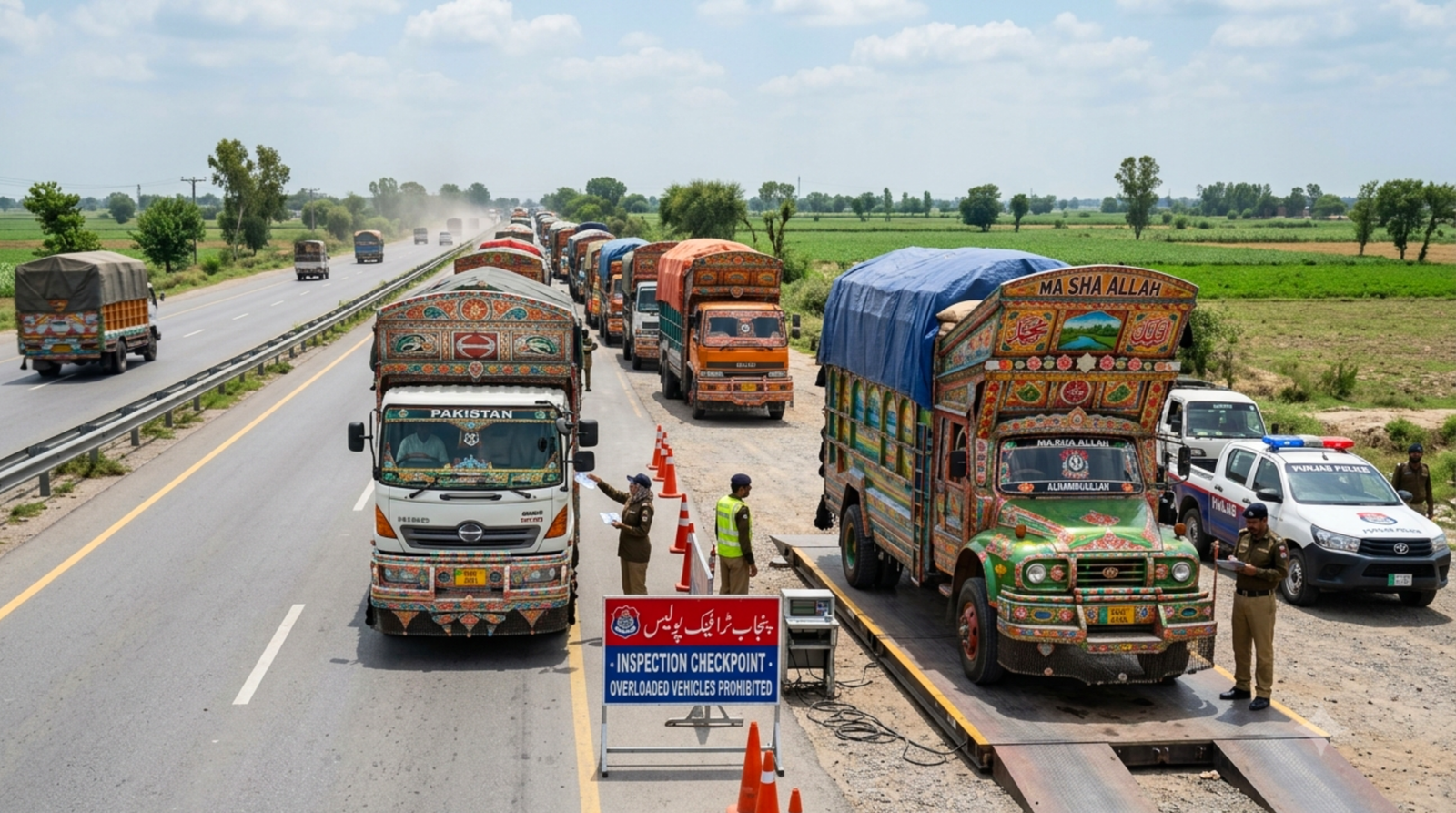
LAHORE — Punjab’s Communication and Works (C&W) Department has moved to a new phase of enforcement against overloaded commercial vehicles, rolling out mobile weighing technology across the province’s highway network and opening the door to private-sector involvement in long-term axle load management.
What Was Announced
The Punjab C&W Department has launched a province-wide initiative to monitor vehicle axle loads and take action against overloading, deploying Mobile Weight Management Systems (MWMS) to check vehicle weight and identify overloaded vehicles on major roads. The department has also decided to adopt a Public-Private Partnership (PPP) model for long-term axle load management.
The decision was taken during a meeting chaired by Punjab Communication and Works Minister Malik Sohaib Ahmad Bherth at the C&W Committee Room, attended by the secretary of communications, a special additional secretary, chief engineers and other relevant officials. Officials told the meeting that MWMS units would be deployed at Kallar Kahar, Choa Saidan Shah Road, Tarbela, Dhok Haliyar in Attock district, Lillah-Jhelum Road and a Multan-area location.
The move formalises an enforcement drive the minister had already flagged in person weeks earlier. During a visit to Lahore Ring Road in late July, Bherth directed authorities to launch an indiscriminate crackdown on overloaded vehicles, emphasising stricter enforcement to improve road safety and travel conditions, after inspecting overloading issues and checkpoint arrangements at Burnanspura, Mehfoozpura, Garrison, Askari-10 and Kamahan. SP Ring Road Police Ejaz Rasheed and Director Operations Shahid Mehboob briefed him on traffic management and enforcement measures during that visit, and the minister instructed officials to take strict legal action against overloaded vehicles without exception, including ensuring heavy vehicles and trailers are properly covered.
The shift from manual checkpoints to mobile axle-weighing units marks a technical upgrade in how the province intends to identify violations, moving enforcement away from discretionary roadside checks toward measured, recorded weight data.
Scale of the Wider Enforcement Campaign
The axle-load initiative sits inside a much larger traffic enforcement effort Punjab Police has been running through 2026. Punjab Police has issued more than 4.843 million driving licences across the province this year, alongside more than 5.830 million traffic challans, with fines exceeding Rs11.16 billion. Within that enforcement, action was taken against 45,881 smoke-emitting vehicles, 6,871 vehicles were impounded at police stations, and the fitness certificates of 28 vehicles were confiscated for violating regulations.
Inspector General of Police Abdul Kareem has directed that the campaign against traffic law violators continue without interruption, ordering an uncompromising crackdown against overloading, over-speeding, underage driving, one-way violations and other offences classed as dangerous to public safety. He also directed District Police Officers and senior officials to strengthen enforcement, with patrolling intensified around commercial centres, highways and city entry and exit points across Punjab.
Legal Framework Behind the Crackdown
The enforcement push follows a broader legislative overhaul of Punjab’s traffic regime. Chief Minister Maryam Nawaz has overseen reforms to the Punjab Traffic Act that include auctioning vehicles repeatedly fined for violations, a crackdown on underage driving and rooftop riding, and a ban on motorcycle rickshaws on five designated model roads. The reforms specify that government vehicles found violating traffic rules will face heavy penalties, with the chief minister stating that no one is above the law, and include a 30-day grace period granted for eliminating one-way violations province-wide. The changes also call for redesigned U-turns to improve road safety and immediate compensation (Diyat) for families of accident victims.
This legal groundwork gives the C&W Department’s axle-load monitoring and the police-led overloading crackdown a formal enforcement basis, rather than treating them as isolated administrative directives.
Parallel Fronts: Emissions, School Transport and Vehicle Age
Overloading enforcement is running alongside, and increasingly overlapping with, several other compliance drives targeting commercial and passenger vehicles in Punjab.
Punjab’s Environment Department has separately targeted commercial and construction vehicles over air pollution, extending its crackdown beyond transport operators to industrial labour transport, courier services, delivery vans, bakery supply vehicles and all commercial vehicles entering Lahore daily. Director General Environment Punjab Musa Raza inspected checkpoints at Thokar Niaz Baig’s Jinnah Terminal and the Saggian entry point, giving transporters of smoke-emitting vehicles a seven-day deadline to bring vehicles into compliance before a zero-tolerance policy takes effect.
School transport has drawn separate scrutiny. The Punjab School Education and Transport Departments, working with district police, have launched an enforcement campaign under the “Safe School Vahan Scheme” after a rise in accidents involving school transport, making school heads directly responsible for safe transportation of students and designating District Education Officers as nodal officers to monitor compliance. Officials attributed most school transport accidents to poor vehicle maintenance and unsafe structural modifications, noting that overcrowded auto-rickshaws and vans remain common during school hours, and said dilapidated or severely overloaded vehicles will be progressively declared unfit for the road.
On vehicle age, Punjab has finalised a phased plan to target old and heavily polluting vehicles starting in Lahore and Faisalabad, introducing digital age-verification technology through the Punjab Information Technology Board and Excise Department, alongside an incentive-based scrappage programme offering rebates to owners trading old vehicles for electric vehicles. Amendments to the Punjab Motor Vehicles Ordinance are under consideration to create a legal basis for age-based restrictions, with a single digital platform tracking vehicle age, emissions and registration records planned for province-wide rollout by 2027.
Taken together, these initiatives point toward a single, data-driven compliance system Punjab is assembling piece by piece — axle load, emissions, fitness and vehicle age — rather than a series of unrelated crackdowns.
Industry and Commercial Fleet Impact
For Pakistan’s road freight and logistics sector, the introduction of mobile weighing units changes the nature of enforcement risk. Where checkpoint inspections have historically relied on visual assessment and officer discretion, MWMS technology produces recorded weight data that is harder to contest, raising the compliance bar for trucking fleets, trailer operators and bulk-goods transporters moving along routes such as Kallar Kahar, the Tarbela corridor and the Attock district network named as initial deployment sites.
The planned Public-Private Partnership model for axle load management suggests Punjab intends to scale weighing infrastructure beyond an initial pilot, potentially through outsourced operation of weigh stations — a model already used in some other jurisdictions for highway load compliance. How the PPP structure is tendered, and which private operators are brought in, will determine how quickly coverage expands beyond the roads named so far.
Transport associations have historically resisted enforcement measures that raise operating costs without warning; goods transporters have previously threatened industrial action over unrelated cost pressures such as fuel pricing. Whether operators view axle-load enforcement as a legitimate safety measure or an added compliance burden will likely shape how smoothly the rollout proceeds, particularly if MWMS units expand to routes carrying higher volumes of overloaded freight ahead of any formal grace period.








Leave a Reply