

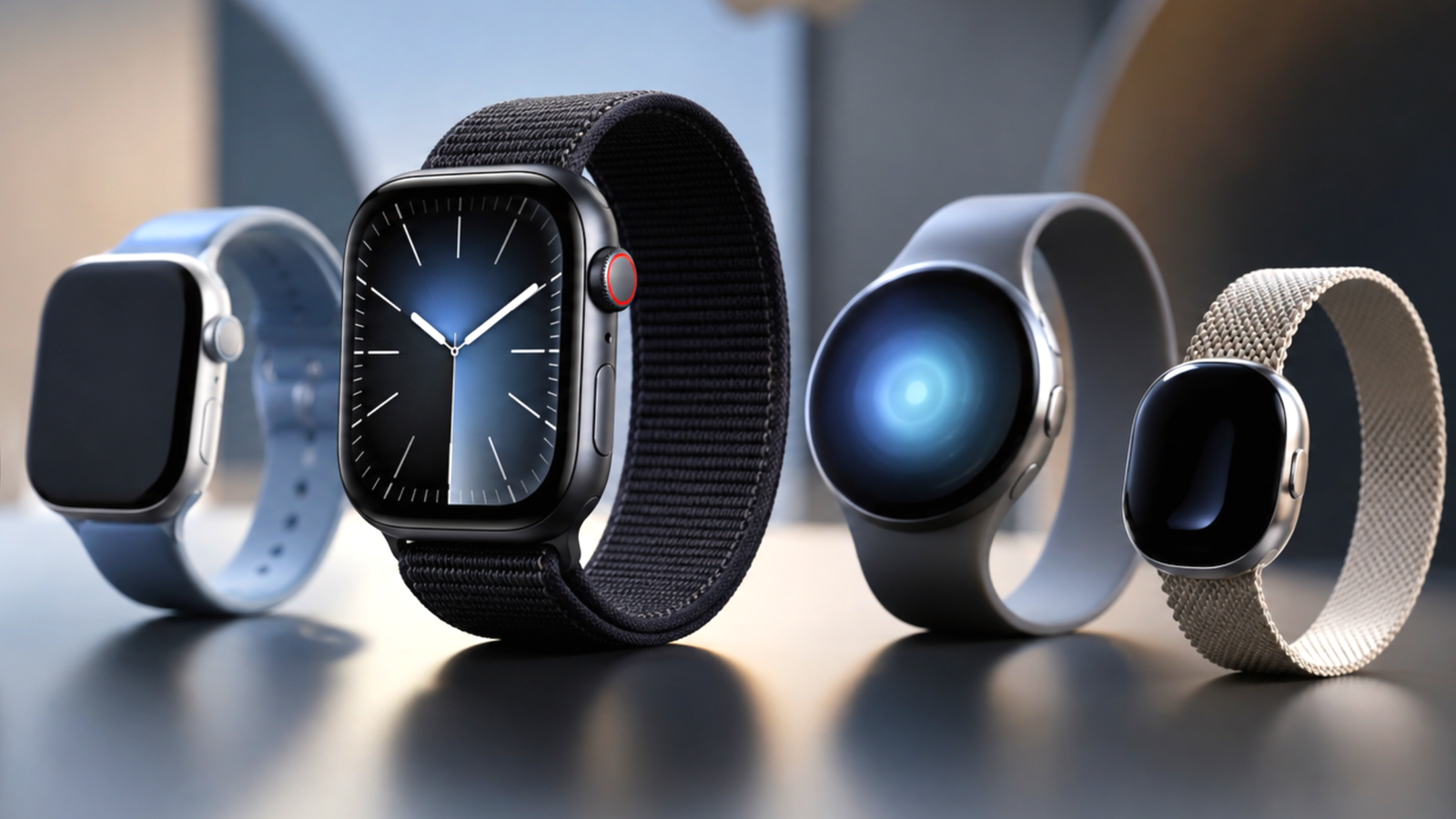
Apple is exploring its most significant Apple Watch redesign since the device launched in 2015, according to Bloomberg journalist Mark Gurman. The company’s industrial design team is reportedly studying concepts that range from a screen-free fitness tracker to a round-faced watch, along with new tiers positioned above and below the current lineup.
Writing in his weekly “Power On” newsletter on Sunday, Gurman said Apple’s design team has spent roughly the past year reconsidering its approach to the smartwatch and has not yet settled on a single direction. Apple is “determined to reinvent the lineup in response to growing competition,” he wrote, citing pressure from screen-free trackers and smart rings that have gained ground on the traditional smartwatch format.
Apple has not publicly confirmed any of the concepts described in the report, and Gurman cautioned that some of the ideas being tested are unlikely to ever reach customers.
What Apple Is Reportedly Weighing
Gurman’s report describes several directions under evaluation inside Apple, though the company has apparently not committed to any of them.
| Concept Under Evaluation | What’s Known So Far |
|---|---|
| Screen-free fitness tracker | No display; a direct response to Oura, Whoop and Google’s Fitbit Air |
| Round-display Apple Watch | Tested internally, but Gurman says it’s unlikely to reach the market |
| New premium tier | Would sit above the current Apple Watch Ultra and Hermès editions |
| More affordable tier | Would sit alongside or below the Apple Watch SE |
| Ceramic case | Last offered in 2016; could resurface as soon as the Series 12 |
| New screen sizes and display types | Under evaluation; specifics not disclosed |
| AI-focused features and Health app overhaul | Described as a long-term goal with no set timeline |
The screen-free concept stands out as the clearest response to a shifting market. Google entered the same category in May 2026 with the Fitbit Air, a screenless, $99.99 tracker that pairs with its Google Health app and, unlike Whoop, does not require a subscription. Oura’s smart rings have also pulled some users away from traditional smartwatches by focusing narrowly on sleep and recovery tracking instead of notifications and apps.
This Year’s Watch Won’t Be Part of It
None of the concepts Gurman described are expected to arrive with this year’s Apple Watch lineup. The Apple Watch Series 12, Apple Watch Ultra 4 and Apple Watch SE 3 are expected to launch alongside the iPhone 18 lineup next month and will carry largely the same design as their predecessors, according to Gurman’s earlier reporting.
Rumored Series 12 changes center on internal upgrades rather than a new look. Apple is expected to give the watch a new chip after reusing the S10 chip across the Series 11, Ultra 3 and SE 3 for a second straight year, and Chinese-language leaks point to a renewed focus on battery life. Touch ID built into the side button and a health sensor embedded directly in the watch band have also circulated as possibilities, but neither Gurman nor Apple supply chain analyst Ming-Chi Kuo has confirmed them, and MacRumors has categorized both as less reliable rumors.
AI and a Health App in Flux
Apple also plans to make its wearables more AI-focused, Gurman reported, alongside longer-term plans to rebuild the Health app. He described Eddy Cue, the Apple executive now overseeing that overhaul, as a longtime user of Whoop and Oura devices who wants Apple’s software to match the personalized coaching those products already offer.
Apple’s Health app ambitions have shifted before. The company had been developing an AI-driven coaching feature known internally as Project Mulberry, first reported in 2023 and once expected to launch as a standalone “Health+” service. That effort was scaled back earlier this year following a leadership change in Apple’s health division, according to earlier reporting, with individual features now expected to reach the existing Health app gradually rather than through a single branded launch.
Why Apple Is Under Pressure
The rethink comes as Apple’s Wearables, Home and Accessories segment, which includes the Watch, AirPods, HomePod and related accessories, has struggled to grow. The category generated $35.69 billion in Apple’s fiscal 2025, a 3.6% decline from the prior year and its third consecutive annual decline, remaining the only Apple product segment still below its fiscal 2022 level. Wearables revenue also fell 2% year-over-year in fiscal first-quarter 2026, to $11.5 billion, a dip that coincided with supply constraints on the AirPods Pro 3 during the quarter.
Unit sales tell a similar story. Global Apple Watch shipments fell to an estimated 33.3 million in 2025, according to market-research figures compiled by Business of Apps, even though the device has held more than half of the global smartwatch market since its debut. Samsung’s Galaxy Watch lineup, Google’s Pixel Watch and dedicated fitness wearables from Garmin and Whoop compete for the same wrist space, while Oura’s rings and the new Fitbit Air have carved out a screen-free category Apple does not currently address.
A Long History of Redesign Rumors
Sunday’s report is not the first time a dramatic Apple Watch overhaul has been rumored. Talk of a so-called “Apple Watch X,” tied to the device’s 10th anniversary in 2025, circulated for roughly three years and predicted a new magnetic band system, a thinner case, a microLED display and blood pressure monitoring. None of it arrived; the last true design change came with the Apple Watch Series 10 in 2024, which introduced a thinner chassis and a larger, wider display.
Separately, a leaker on the Chinese platform Weibo known as Instant Digital claimed in late June that the 2027 Apple Watch would adopt a new band-attachment system, breaking compatibility with existing bands to make room for a larger battery. That same leaker has since revised the timeline in a more recent post, saying Apple’s 2027 plans remain “uncertain” and that a full redesign may not arrive until 2028. Gurman’s report does not name a target year for the changes it describes, underscoring how unsettled Apple’s plans still appear to be even inside the company.
Apple Watch in Pakistan
Apple has no official retail presence in Pakistan, and the Apple Watch reaches the country entirely through authorized and independent resellers, who import units and register them with the Pakistan Telecommunication Authority to enable cellular connectivity. Pakistani retailers currently list current-generation models from roughly PKR 55,000 for the entry-level Apple Watch SE 3 to more than PKR 250,000 for the Apple Watch Ultra 3, though listed prices vary noticeably between resellers and shift with the dollar exchange rate.
Pakistan’s broader smartwatch market remains dominated by budget and mid-range brands such as Xiaomi, Huawei, Amazfit and local names including Dany Technologies, which sell in far higher volumes than premium wearables. Should Apple eventually bring a redesigned Watch to market, it would likely reach Pakistani buyers through the same import-based reseller model used today, since Apple has not announced any plans for direct retail or distribution in the country.
What Happens Next
Apple is expected to unveil the Series 12, Ultra 4 and SE 3 alongside the iPhone 18 lineup in September, with none of the changes described in Sunday’s report. Gurman has not said when Apple might finalize or release any of the more ambitious concepts, and the company has not offered a public timeline of its own. For now, the report describes a direction under internal consideration rather than a confirmed product, and further details are likely to surface gradually as Apple’s plans take clearer shape.













Leave a Reply