

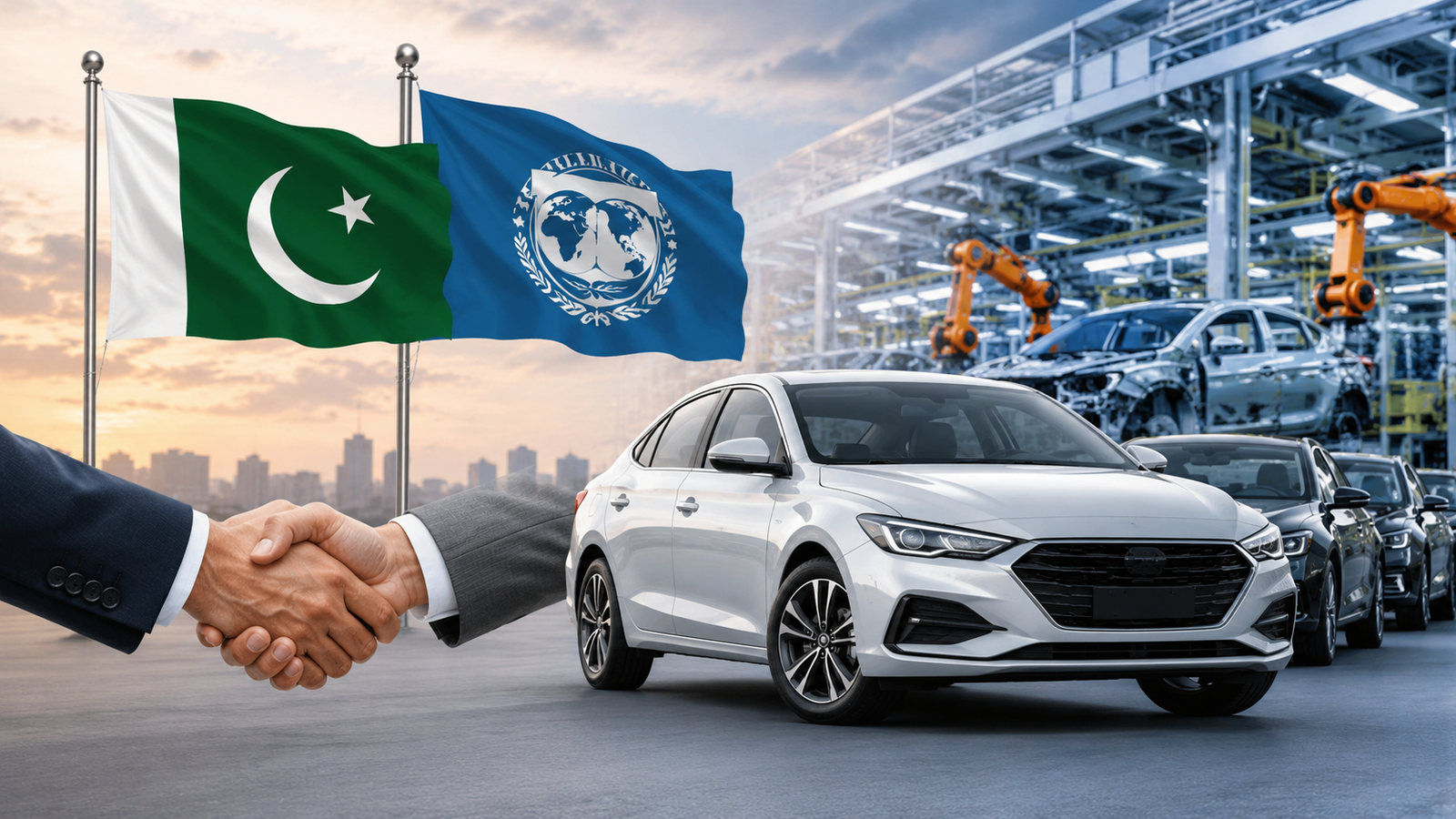
Islamabad — July 2026: Pakistan’s long-awaited Auto Policy 2026-31 has hit another roadblock, with the government now set to roll over the outgoing automobile policy for a further twelve months after negotiations between Islamabad, the International Monetary Fund (IMF), and the Tariff Policy Board failed to produce a consensus. The development means car buyers, local assemblers, and prospective EV investors will continue operating under the old framework, at least in the near term, as officials scramble to iron out disagreements over taxation and tariff structures.
Why the New Auto Policy Stalled
The previous automobile policy formally lapsed at the end of June 2026, but the government has been unable to finalize its replacement. According to officials familiar with the matter, Pakistan’s negotiating team could not adequately defend key elements of the proposed policy during consultations with the IMF, leaving the talks inconclusive. An anonymous government source told local media that authorities had also struggled to fully implement the previous policy, compounding the pressure to get the new one right rather than rush it through.
Prime Minister Shehbaz Sharif has reportedly expressed concern over the repeated delays in rolling out the new framework and has directed officials to draft a more investor-friendly policy — one geared toward attracting fresh manufacturing investment, expanding local production capacity, and generating employment across the automotive value chain.
The Core Dispute: Tax Breaks for Electric and Hybrid Vehicles
At the heart of the impasse is a disagreement over sales tax treatment for new energy vehicles (NEVs), including electric and hybrid cars. Pakistani authorities had proposed a sharply reduced 1% sales tax on NEVs for a five-year window, along with a 9% rate — half the standard charge — on hybrid vehicles. The IMF rejected this approach outright, insisting that the standard 18% General Sales Tax (GST) should apply uniformly across all vehicle categories. The Fund’s position is that if the government wants to make green vehicles more affordable, it should do so through direct, targeted subsidies rather than blanket tax exemptions, which it views as fiscally distortive and revenue-eroding.
The dispute isn’t limited to NEVs. The IMF has also pushed back on a separate proposal to cut sales tax on small 800cc vehicles from 18% to 12.5%, a move officials had hoped would offer relief to budget-conscious buyers. Sources say Islamabad will now consult the Fund further before finalizing any tax-related measures in the eventual policy.
Ministries Divided on Tariffs
Compounding the external pressure from the IMF is an internal rift between Pakistan’s own ministries. The Ministry of Industries and Production and the Ministry of Commerce have reportedly been unable to agree on how steeply import tariffs and duties should be cut, and by what timeline. One option reportedly under consideration by the industries side pairs a 74% tariff reduction with an 82% Federal Excise Duty to preserve effective pricing — a formula that has drawn criticism from industry watchers who argue it undercuts the very tariff liberalization the IMF is asking for.
Adding to the confusion, some officials have argued that the industry ministry’s proposed 15% tariff cap was never actually an IMF requirement — the Fund’s real benchmark is a weighted-average tariff below 6%, a target achievable even with duty rates as high as 50% in select categories.
What the Draft Auto Policy 2026-31 Proposed
Even in draft form, the proposed policy signaled the most significant shift in Pakistan’s protectionist auto sector in years. Key elements included:
- Tariff liberalization: A reduction in the weighted-average tariff on vehicle imports from 10.6% to 7.4% by 2030, with an interim drop to roughly 9.5% expected in the FY2026-27 budget.
- New tariff slabs: Proposed duty bands of 0%, 5%, 10%, and 15%, with customs duty on finished vehicles capped at 15% over a five-year phase-in.
- Parts and components relief: Duties on imported auto parts potentially cut by up to half over five years, easing costs for local assemblers.
- Used-car imports: The existing 40% regulatory duty on commercial imports of used vehicles was set to taper down by 10 percentage points annually starting mid-2026, reaching zero by FY2029-30.
- NEV adoption target: A push toward electric and hybrid vehicles making up 30% of new car sales by 2030, aligned with the New Energy Vehicle Policy 2025-30.
- Production goals: An ambitious target of 500,000 units in annual output by 2031 — well above current annual sales of roughly 150,000 to 180,000 units, despite installed capacity nearing half a million units.
- Safety standards: Alignment of locally manufactured and imported vehicles with 62 international safety standards under United Nations guidelines, with penalties for companies that fail to comply.
Industry Reaction
The delay has drawn sharp commentary from within the automotive sector. Muhammad Ali Tabba, Chairman of Lucky Motor Corporation — which assembles Kia and Peugeot vehicles and is bringing China’s GAC EV brand to Pakistan — has cautioned against cross-subsidizing sales tax and Federal Excise Duty across conventional, hybrid, and electric vehicle categories, warning that doing so effectively penalizes petrol and diesel buyers to make EVs appear artificially cheaper.
Industry analysts have also flagged a broader pattern of inconsistency: overseas vehicle-import schemes were restricted early on, followed by stringent new entry requirements — including a reported $350 million capital threshold and three-year dealership commitments — before any corresponding tariff relief materialized. Critics argue this sequencing has left both established assemblers and newer Chinese and Korean entrants operating in a state of prolonged policy uncertainty.
Indus Motor Company CEO Ali Asghar Jamali and economist Dr. Faisal Bari have both pointed to policy inconsistency, rather than the absence of a policy altogether, as the sector’s more fundamental problem.
What This Means for Car Buyers
For now, the practical impact on consumers is limited: the extension of the existing policy means current pricing structures, duty rates, and incentive schemes remain largely unchanged in the immediate term. Industry commentators have cautioned that the Budget 2026-27 offered only limited relief — mainly extended CKD (completely knocked down) import incentives — with no broad-based price cuts. Small cars such as entry-level hatchbacks may be a partial exception, but most vehicle categories are not expected to become cheaper in the short run.
Electric vehicle buyers, meanwhile, continue to have access to an existing government subsidy pool of Rs100 billion allocated through June 2030, with individual EV purchasers eligible for subsidies of up to Rs80,000. However, the sector still faces structural hurdles: no public EV charging stations have yet been established nationwide, despite operating licenses having already been issued to more than 100 companies, and locally produced batteries currently meet only a small fraction of overall demand.
The Bigger Picture: IMF Program Compliance
The auto policy negotiations are unfolding under the shadow of Pakistan’s broader $7 billion Extended Fund Facility with the IMF. Tariff and tax reforms tied to the automobile sector form part of the government’s structural commitments under that program, and the Fund’s insistence on uniform taxation reflects its wider push for fiscal discipline and reduced revenue leakage across Pakistan’s economy.
With formal negotiations unlikely to conclude in the coming weeks, officials say a one-year rollover of the existing auto policy is now the most probable outcome, buying time for the Ministry of Industries, the Ministry of Commerce, the Federal Board of Revenue, and the IMF to reach common ground on a revised framework — one that still aims to eventually take effect, but on a timeline yet to be confirmed.




Leave a Reply