

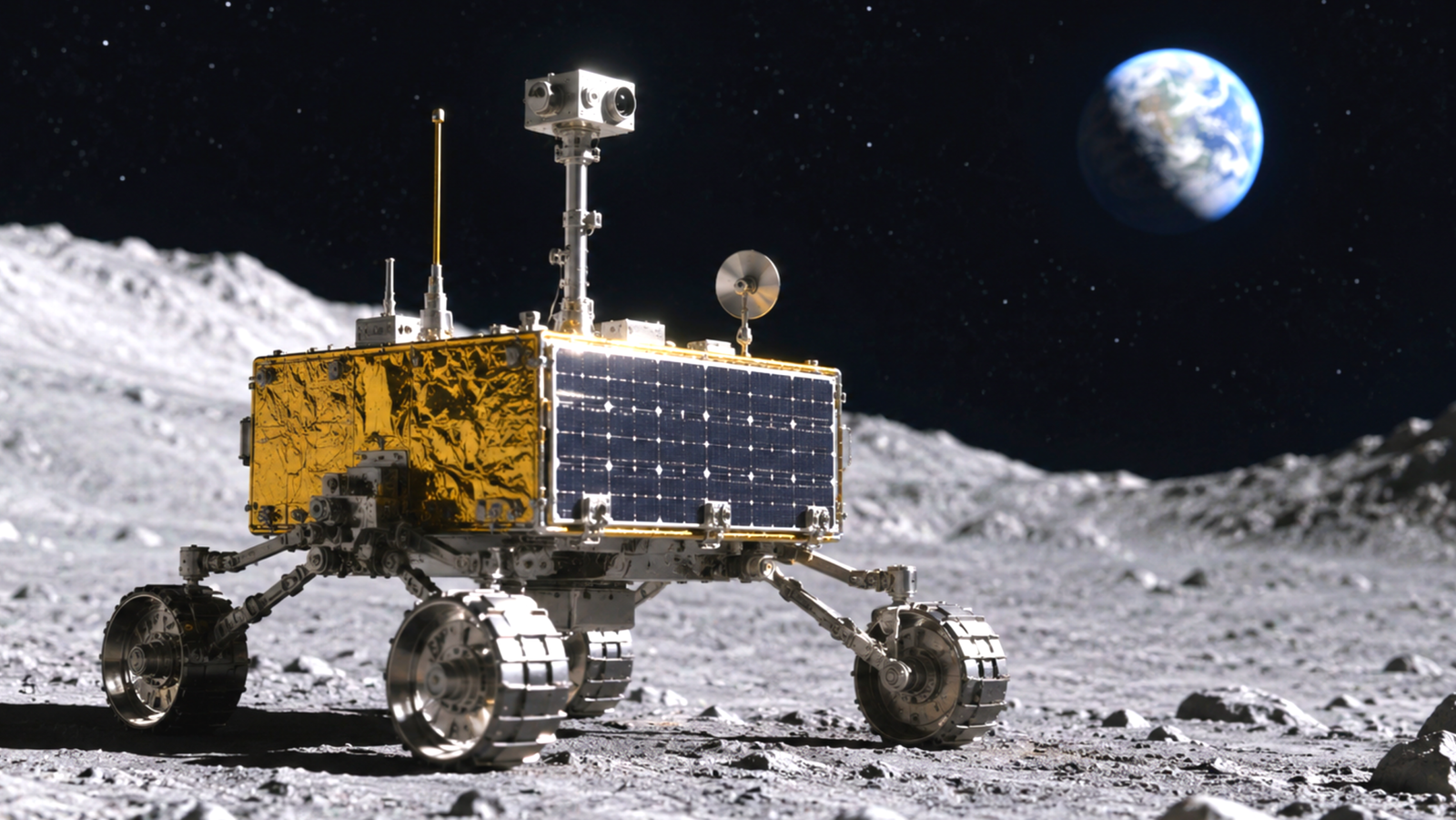
ISLAMABAD, Aug. 13 — Pakistan’s national space agency on Thursday unveiled the name of the country’s first lunar rover: Jinnah-1, after Muhammad Ali Jinnah, the founder of Pakistan. The announcement, made at a ceremony at the headquarters of the Space and Upper Atmosphere Research Commission (SUPARCO), caps an 18-month public naming campaign and marks Pakistan’s first attempt to put a robotic vehicle on the lunar surface, rather than simply into orbit around it.
The rover is scheduled to travel to the Moon’s south pole as a payload aboard China’s Chang’e-8 mission, a robotic lander-and-rover mission that the China National Space Administration (CNSA) has described as targeting a launch window around 2029.
How ‘Jinnah-1’ Was Chosen
SUPARCO opened its “Name Pakistan’s Lunar Rover” competition to the public in early 2025, inviting students, space enthusiasts and members of the public nationwide to submit proposed names along with a short rationale, with a cash prize of Rs 100,000 on offer for the winner. The contest drew roughly 4,000 submissions from across the country.
Among the entries, seven separate participants had independently proposed the name “Jinnah-1.” SUPARCO selected it as the rover’s official name, then held a lucky draw among the seven to determine which entrant would be publicly credited and receive the prize money. Seventeen-year-old Tayyab Karim, from Bahawalnagar in Punjab, was announced as the winner at Thursday’s ceremony.
Addressing the event, SUPARCO Chairman Muhammad Yousuf Khan said the name honors the founder of Pakistan and was chosen to reflect the country’s determination and progress in space exploration, adding that Jinnah-1 marks a milestone in expanding Pakistan’s scientific and technological capabilities.
What Jinnah-1 Is — and Isn’t
Jinnah-1 is a rover: a wheeled robotic vehicle designed to move across the lunar surface, rather than an orbiter that circles the Moon from above. That distinction matters for Pakistan’s space program. In May 2024, Pakistan sent its first spacecraft to the Moon, a roughly 7-kilogram CubeSat called iCube-Qamar, which rode to lunar orbit aboard China’s Chang’e-6 sample-return mission and photographed the surface using two onboard cameras. It never touched down. Jinnah-1, by contrast, is intended to land, drive across lunar terrain and operate instruments directly on the surface — a considerably more demanding undertaking.
According to SUPARCO, the rover has a mass of around 35 kilograms and has been designed, built, assembled and tested by Pakistani engineers and scientists. Once on the Moon, it is expected to be operated remotely by teams in Pakistan.
| Feature | Details |
|---|---|
| Name | Jinnah-1 |
| Type | Robotic lunar rover (surface vehicle) |
| Operator | SUPARCO (Pakistan) |
| Approximate mass | 35 kg |
| Host mission | China’s Chang’e-8 (CNSA) |
| Target landing zone | Lunar south pole region (Leibnitz Beta / Mons Mouton area) |
| Planned launch | Around 2029, per SUPARCO |
| Development | Designed, built and tested by SUPARCO; carries an internationally developed payload |
| Ground operations | To be controlled remotely from Pakistan |
SUPARCO says Jinnah-1’s science payload is intended to study the Moon’s plasma environment, radiation levels and surface geology, and to support research relevant to future long-duration human activity on the Moon. The rover will carry instrumentation developed by SUPARCO alongside a jointly developed payload built through Chinese-European collaboration, according to the agency.
A Slot on a Bigger Chinese Mission
Jinnah-1’s path to the Moon runs through Beijing. Pakistan’s rover will fly as one of several international payloads aboard Chang’e-8, a CNSA mission built around exploring the lunar south pole and testing technologies — including 3D-printing construction material from lunar soil — that China wants to use later this decade to begin building the China-led International Lunar Research Station (ILRS).
SUPARCO and CNSA formally agreed to include the Pakistani rover on Chang’e-8 through a Memorandum of Understanding signed in February 2025, during a state visit to China by President Asif Ali Zardari, in the presence of Zardari and Chinese President Xi Jinping. At the time, both the MoU announcement and CNSA’s own public statements described Chang’e-8 as targeting a 2028 launch; CNSA has more recently described the mission’s window as being around 2029, and Thursday’s SUPARCO announcement used that later figure. As with many multi-year robotic missions, the exact launch date may still shift before liftoff.
Pakistan is one of several countries contributing hardware to Chang’e-8. CNSA has said the mission’s roughly 200 kilograms of internationally available payload space includes contributions from Turkey, Italy, Russia, Thailand, Bahrain, Egypt, Iran, South Africa, Peru and Hong Kong alongside Pakistan — spanning a rover, a multi-function robot, laser retroreflectors, and instruments for studying dust, radiation and lunar geology. China’s precursor mission to the same region, Chang’e-7, has been targeting a launch as soon as this year.
Building on the iCube-Qamar Mission
Jinnah-1 extends a partnership that began with iCube-Qamar, developed by Islamabad’s Institute of Space Technology (IST) together with SUPARCO and Shanghai Jiao Tong University. That CubeSat’s launch made Pakistan the sixth country to place a satellite in lunar orbit, and Prime Minister Shehbaz Sharif publicly congratulated the mission team at the time, describing the CubeSat as Pakistan’s first step into space.
SUPARCO itself dates back to 1961, making it one of the world’s older national space agencies; physicist Abdus Salam served as its first chairman. Khan, appointed in October 2023, is the first career scientist to lead the agency in more than two decades, following a long stretch during which SUPARCO was headed by senior military officers. Under his tenure, the agency has also launched Pakistan’s first indigenous Electro-Optical Earth-observation satellite, in January 2025.
| Milestone | Date |
|---|---|
| iCube-Qamar launched (lunar orbiter) | May 2024 |
| SUPARCO–CNSA MoU signed for Chang’e-8 rover slot | February 2025 |
| Public naming competition opened | February 2025 |
| Rover officially named “Jinnah-1” | August 13, 2026 |
| Planned launch aboard Chang’e-8 | Around 2029 |
What Happens Next
With the name finalized, SUPARCO’s next milestones are completing the rover’s build and qualification testing, and integrating it with the Chang’e-8 spacecraft ahead of a launch that CNSA has not yet fixed to an exact date. SUPARCO has not released a detailed public timeline for those remaining steps. If the mission proceeds as planned, Jinnah-1 would make Pakistan one of a small group of nations — alongside established space powers and newer entrants such as Turkey — operating a robotic vehicle on the lunar surface, several years after Pakistan’s first CubeSat reached lunar orbit.















Leave a Reply