

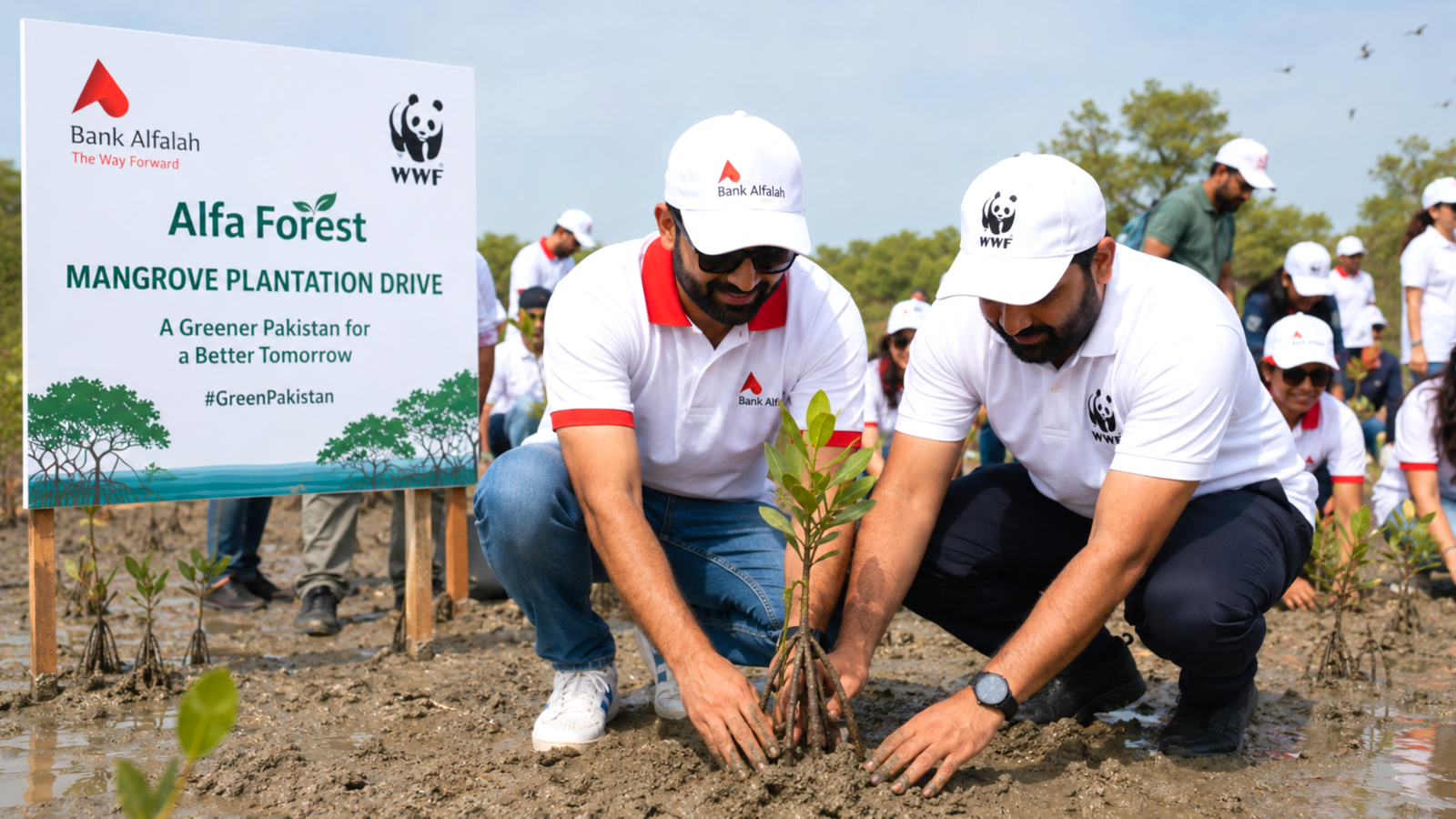
KARACHI: Bank Alfalah and WWF-Pakistan carried out a mangrove plantation drive at the WWF-Pakistan Wetland Centre in Karachi, the bank said in a statement issued Monday, converting the digital banking activity of more than a million customers into physical tree planting along Pakistan’s coastline.
The drive was held to mark Pakistan’s Independence Day on August 14 and falls under Bank Alfalah’s “Alfa Forest” programme, a feature built into the bank’s mobile application, Alfa App, that allows customers to contribute toward mangrove plantation through their routine digital banking transactions. The bank described the Karachi event as the next phase of the initiative, moving from digital participation to on-ground environmental action in partnership with WWF-Pakistan.
According to the statement, Alfa App has 1.4 million active users, of whom more than 1 million have taken part in Alfa Forest, with each participating customer’s activity enabling the plantation of a mangrove sapling on their behalf. The bank did not disclose how many saplings have been planted through Alfa Forest specifically, distinct from its wider mangrove commitments with WWF-Pakistan.
The plantation activity in Karachi brought together Bank Alfalah employees, WWF-Pakistan representatives, environmental experts and volunteers, according to the joint statement issued by the two organisations.
Bank Alfalah Chief Digital Officer Muhammad Yahya Khan, speaking at the event, said “technology can be a powerful enabler of positive change,” adding that Alfa Forest allows customers to support conservation simply by banking digitally, and that the partnership with WWF-Pakistan converts that participation into concrete action supporting the restoration of Pakistan’s coastal ecosystems.
Rab Nawaz, WWF-Pakistan’s Senior Director for Programmes, represented the conservation organisation at the event. He described mangrove forests as playing a vital role in protecting coastlines, storing carbon, preserving biodiversity and sustaining the livelihoods of local communities, and said WWF-Pakistan valued the bank’s continued environmental commitment and the opportunity to combine public participation with measurable conservation outcomes.
Bank Alfalah said the initiative forms part of its broader Environmental, Social and Governance (ESG) strategy, intended to build climate resilience while raising environmental awareness among its customers, employees and the wider community.
For customers, participation in Alfa Forest is tied to activity on the Alfa App rather than a separate financial contribution, according to the bank, meaning the initiative carries no additional cost to those enrolled. The programme has no tax, regulatory or pricing implications for consumers, businesses or investors, and is distinct from carbon credit schemes. Its practical effect, according to researchers who study the Indus Delta, is incremental: additional mangrove cover contributes marginally to the storm protection, fish-breeding habitat and livelihood support that the wider ecosystem already provides to coastal and fishing communities in Sindh, without altering existing coastal management policy.
Monday’s event is the latest in a series of mangrove-related partnerships between Bank Alfalah and WWF-Pakistan dating back to 2023, when the bank launched its #GreenWayForward campaign by planting 15,000 mangrove saplings at WWF-Pakistan’s wetland site in Sandspit, Karachi, a figure chosen to represent the bank’s total employee strength at the time. WWF-Pakistan, which has worked on conservation in Pakistan since 1970, committed to a year of monitoring and replacing saplings under that programme to ensure their survival.
In June 2024, the two organisations marked World Environment Day by pledging to plant a further 25,000 mangroves along the Balochistan coastline. Both campaigns were presented as steps toward a broader commitment, first announced in 2023, to plant 100,000 mangrove trees by 2030 in partnership with WWF-Pakistan. Bank Alfalah has since expanded its environmental partnerships with WWF-Pakistan to include conservation of the endangered Indus River blind dolphin and, separately, an urban forestry project with the Karachi Metropolitan Corporation and Indus Earth Trust at Ibn-e-Qasim Park.
Bank Alfalah is a publicly listed commercial bank trading on the Pakistan Stock Exchange under the symbol BAFL, and is regulated by the State Bank of Pakistan. Majority owned by the Abu Dhabi Group, the bank reported total assets of more than Rs 3.7 trillion for 2024 and operates a domestic network of close to 900 branches across more than 200 cities, alongside operations in several other countries.
Pakistan’s mangrove forests are concentrated along roughly 1,050 kilometres of coastline shared by Sindh and Balochistan provinces, with about 97 percent of national mangrove cover located in the Indus Delta in Sindh, according to researchers who study the ecosystem. The delta is regarded as one of the largest arid-climate mangrove ecosystems in the world. Unlike many mangrove regions globally, Pakistan has recorded an expansion in mangrove cover over the past three decades, reversing an earlier decline driven by reduced freshwater flows from the Indus River, upstream damming and diversion, pollution and overharvesting for fuel and fodder.
Mangroves function as a natural buffer against storm surges and coastal erosion, provide breeding habitat for fish and shrimp species that sustain coastal fishing communities, and are recognised as efficient carbon sinks, storing substantially more carbon per hectare than many terrestrial forests. Pakistan’s National Climate Change Policy identifies mangroves and other coastal ecosystems as a nature-based solution for both climate adaptation and mitigation.
Under Pakistan’s constitutional framework, forestry and wildlife are provincial subjects, placing primary regulatory responsibility for mangrove conservation with the Sindh and Balochistan forest departments. The federal Ministry of Climate Change and Environmental Coordination oversees national climate policy and issues clearances required for international carbon credit transactions involving Pakistani ecosystems.
Corporate plantation drives such as Alfa Forest operate on a markedly smaller scale than the Sindh government’s Delta Blue Carbon project, a public-private partnership between the Sindh Forest Department and private developers that is restoring mangroves across roughly 600,000 hectares of the Indus Delta. That project had generated about $40 million in international carbon credit sales as of 2023, with Sindh officials targeting cumulative carbon revenue of up to $12 billion by 2075. Bank Alfalah’s initiative is not linked to that programme and does not generate carbon credits; it functions instead as a standalone corporate contribution to the same broader conservation landscape.
Bank Alfalah said it would continue working toward its 2030 target of planting 100,000 mangroves in partnership with WWF-Pakistan, with the Alfa Forest programme remaining open to customer participation through the Alfa App. Neither organisation announced a specific date, location or sapling target for the next phase of plantation activity.













Leave a Reply