

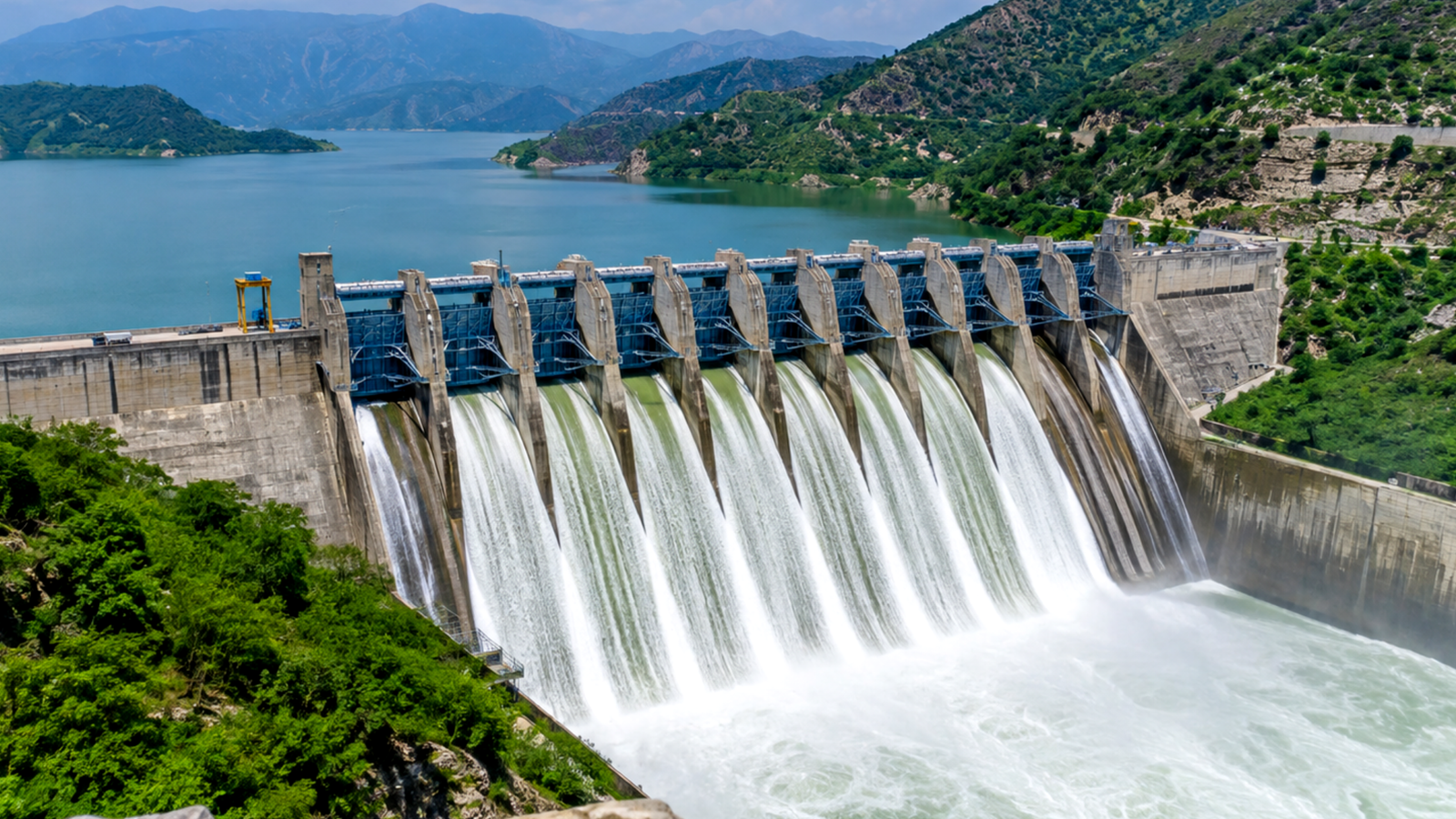
ISLAMABAD — Tarbela Dam, one of Pakistan’s two principal multipurpose reservoirs on the Indus River system, reached its maximum conservation level of 1,550 feet on Sunday, according to data from the flood forecasting division of the Pakistan Meteorological Department (PMD).
The water level at the dam, located on the Indus River in Khyber Pakhtunkhwa’s Haripur district, stood at 1,549.48 feet at 6pm on Sunday, up from 1,549 feet recorded at 6am the same day, the PMD’s flood forecasting division reported. Live storage in the reservoir reached 5.523 million acre-feet (MAF), against a minimum operating, or dead, level of 1,402 feet.
The filling comes amid an active monsoon season, with officials attributing the rapid rise to sustained rainfall and glacier melt in the upper Indus basin, which have pushed inflows into the reservoir well above seasonal averages.
Filling ahead of previous years
This year’s filling pace has outpaced the same period in each of the past two years. On the same date in 2024, Tarbela had reached only 90 percent of its storage capacity; by the same date in 2025, it stood at 96 percent. This year, the reservoir touched its full 1,550-foot mark on that date — a level it had not reached at all in either 2023 or 2024, when it peaked at 1,548 feet and 1,549 feet, respectively, before receding. Tarbela also reached the 1,550-foot ceiling last year, making 2026 the second consecutive season the dam has filled to capacity, and doing so at a faster pace than in 2025.
A day earlier, on Saturday, the National Disaster Management Authority (NDMA), through its National Emergencies Operation Centre (NEOC), had reported Tarbela at 97.94 percent of capacity at a level of 1,548 feet, compared with 95.98 percent on the corresponding day last year. The same NDMA assessment placed Mangla Dam, Pakistan’s other major reservoir, on the Jhelum River, at 62.99 percent of capacity, with a water level of 1,205.2 feet, against 62.80 percent a year earlier.
Earlier in the filling season, official water data released on August 3 had shown the country’s combined reservoir storage — across Tarbela, Mangla and the Chashma Barrage — at 9.466 MAF, roughly 72 percent of Pakistan’s total 13.149 MAF storage capacity. At that point, Tarbela was already 90.72 percent full, receiving inflows of about 219,700 cusecs against outflows of roughly 162,000 cusecs, while Mangla lagged due to comparatively weak rainfall over the Jhelum catchment.
Why it matters
The filling of Tarbela to its maximum conservation level strengthens the country’s irrigation supply position heading into the Rabi cropping season, which begins in October, and signals healthy carryover storage that can cushion against dry spells later in the year.
The current position stands in sharp contrast to conditions during the 2024-25 Rabi season, when the Indus River System Authority (IRSA) warned in March 2025 that both Tarbela and Mangla were nearing their dead levels, prompting a 30 to 35 percent water shortage advisory for the remainder of that season. Punjab and Sindh had each reported double-digit shortfalls against demand at the time, forcing provincial irrigation departments to ration supplies for the standing wheat crop. By contrast, Pakistan entered the 2025-26 Rabi season with reservoirs holding more than 13.1 MAF, about 99 percent of peak capacity, after Tarbela and Chashma both touched record conservation levels the previous September. This year’s early filling suggests the country may again enter the Rabi season from a position of relative strength, though officials caution that final storage levels will still depend on rainfall through the remainder of the monsoon.
Impact on farmers, power generation and flood management
For farmers in Punjab and Sindh, higher reservoir levels typically translate into more reliable canal water supplies for standing Kharif crops such as cotton, rice and sugarcane, and improved prospects for timely wheat sowing once the Rabi season opens. Provincial irrigation departments draw on IRSA’s seasonal water-sharing calculations, based on the 1991 Water Apportionment Accord, to allocate releases from Tarbela and Mangla between the provinces; healthier reservoir levels generally reduce the likelihood of the kind of shortfall-driven rationing seen in early 2025.
Tarbela also hosts Pakistan’s largest single hydropower complex, with an installed generation capacity of 4,888 megawatts, accounting for more than half of the electricity generated by projects associated with the Water and Power Development Authority (WAPDA). With the reservoir at its conservation ceiling, WAPDA typically shifts to “run of the river” operations, releasing water downstream at a rate matching inflows rather than continuing to build storage — a mode that can support sustained hydel generation, a comparatively low-cost source of electricity relative to imported fuel-based thermal power.
A full reservoir also carries downstream implications for flood management. Because Tarbela can no longer absorb additional inflows once at capacity, any further surge in water arriving from the Kabul and Indus rivers — including flows measured at gauging points such as Nowshera and Khairabad Bridge — must largely be passed downstream unmoderated. The NDMA and provincial disaster management authorities in Khyber Pakhtunkhwa and Punjab have said they are continuing to monitor river flows as the monsoon persists, a standard precaution during periods of high reservoir storage.
Economic implications
Reservoir storage carries implications beyond agriculture and power. Water availability affects crop output, which factors into food inflation readings tracked by the State Bank of Pakistan (SBP) and into GDP growth estimates, given agriculture’s roughly one-fifth share of the economy. On the power side, higher hydel generation displaces costlier furnace-oil and LNG-based output, a factor the National Electric Power Regulatory Authority (NEPRA) and power-sector planners weigh when estimating fuel-cost adjustments passed on to consumers.
Background
Tarbela Dam, an earth-and-rock-fill structure on the Indus River, was built between 1968 and 1976 under the Indus Basin Project that followed the 1960 Indus Waters Treaty. It was designed with a gross storage capacity of 11.6 MAF at its maximum lake elevation of 1,550 feet, with a net usable capacity of 9.7 MAF. Decades of sediment accumulation have since reduced the dam’s usable live storage well below its original design figure, a trend that has periodically prompted remodelling and capacity-extension work by WAPDA.
What happens next
Officials said monitoring of both reservoirs would continue through the remainder of the monsoon season, particularly at Mangla Dam, where additional rainfall over the Jhelum basin in the coming weeks is considered important to raising storage closer to its own conservation ceiling before Rabi sowing begins. IRSA’s advisory committee typically finalises seasonal water-sharing allocations for Punjab, Sindh, Khyber Pakhtunkhwa and Balochistan ahead of the Rabi season based on final pre-season storage figures, a process expected in the coming weeks as the current filling season winds down.













Leave a Reply