

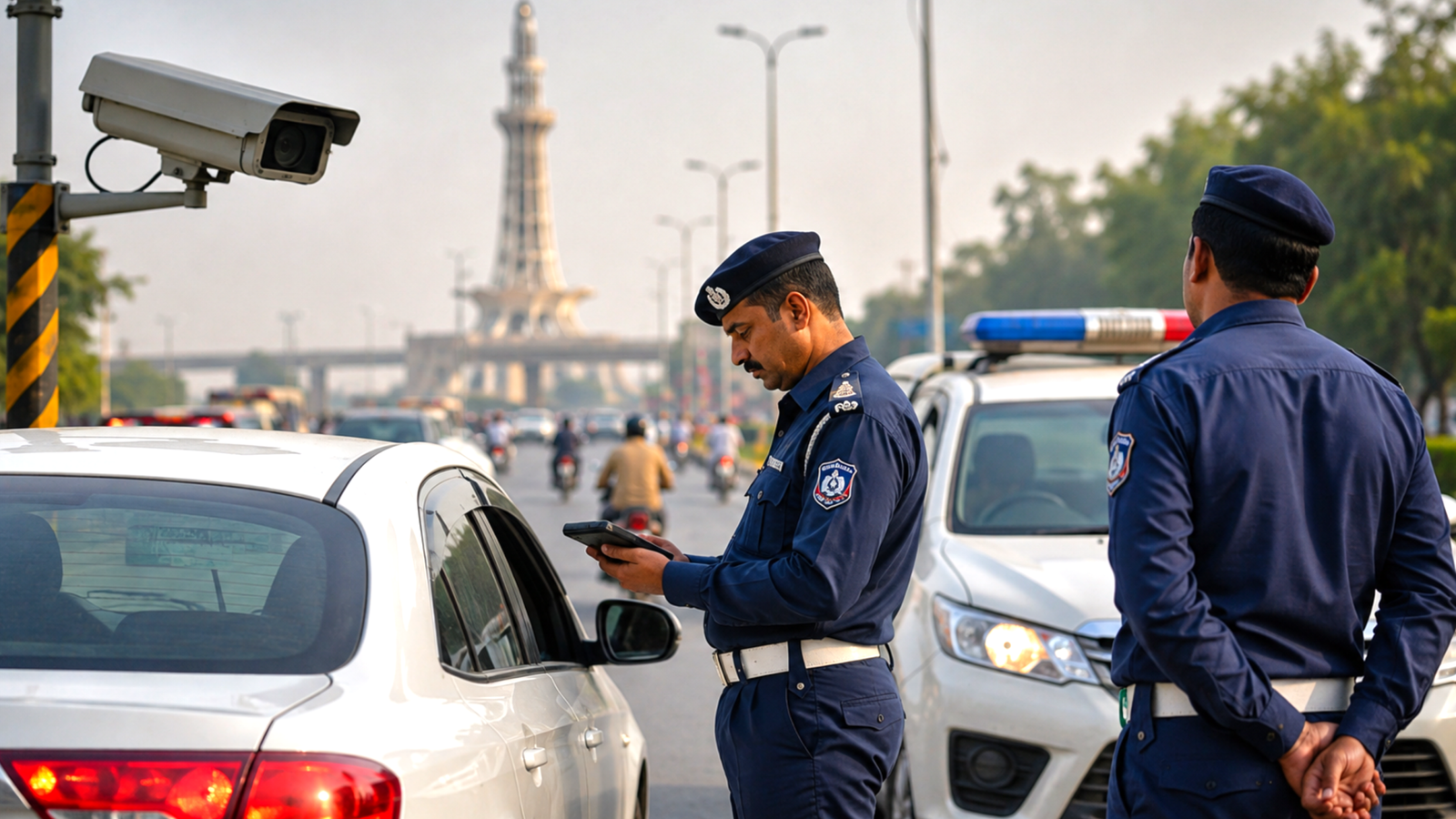
LAHORE — Lahore traffic police have opened a targeted enforcement drive against the city’s 100 worst e-challan defaulters, and the campaign has already produced its first arrest: a pickup driver accused of hiding more than 80 unpaid violations behind a fake number plate.
Chief Traffic Officer (CTO) Syed Abdul Rahim Shirazi confirmed Aug. 9 that recovery squads had been handed a list of the 100 vehicles carrying the highest volume of unpaid e-challans — electronically issued traffic citations generated when Automatic Number Plate Recognition (ANPR) cameras detect violations such as speeding, red-light running or improper lane use. Shirazi ordered the squads to track and, where necessary, seize the flagged vehicles in coordination with the Punjab Safe Cities Authority (PSCA), which operates the city’s surveillance camera network.
First Arrest Under the New Phase
The initiative’s first confirmed case involved a pickup ranked among the top 10 defaulters on the list. Police said the vehicle had accumulated 80 recorded violations and more than Rs 410,000 (roughly $1,470) in outstanding fines. After learning his vehicle had been flagged, the driver allegedly fitted it with a counterfeit number plate rather than clear the balance. Police said the vehicle went on to rack up a further Rs 21,000 in e-challans issued against the fake registration before officers caught up with it.
The driver was arrested along with the vehicle, and a case was registered at Nawan Kot police station on charges connected to the fake plate. Authorities said he remains liable for the original fine total in addition to any penalties tied to the fraud case.
Restrictions and Enforcement Mechanics
Beyond impoundment, Lahore police have cut off 14 government services to drivers with unpaid e-challans, including driving-license issuance, character certificates and various police verification facilities — a measure meant to make ignoring a challan more costly than paying it. Shirazi has described the approach as zero-tolerance: any flagged vehicle stopped during routine patrols must clear its outstanding balance before officers release it. Enforcement teams have been posted along high-traffic corridors including Mall Road, Jail Road, Gulberg, Ferozepur Road and Wahdat Road to intercept vehicles on the list.
The system runs on infrastructure PSCA has built up since its creation under the Punjab Safe Cities Ordinance of 2015. ANPR cameras installed across Lahore identify more than 20 categories of traffic violation and generate challans automatically, each backed by time-stamped photographic evidence. A newer digital-evidence layer, extended across Punjab this year, is designed to make individual challans harder to dispute and easier to enforce against repeat offenders.
A Campaign That Has Been Building for Over a Year
The top-100 list is the latest stage of an enforcement push that has escalated steadily since mid-2025. Then-CTO Dr. Athar Waheed opened an earlier phase in May 2025 targeting the 1,000 worst-offending vehicles citywide, deploying a dozen recovery teams that impounded roughly 300 vehicles within its first weeks. That sweep surfaced cases including a single motorcycle carrying 313 unpaid violations, and a separate review found 3,896 government-owned vehicles with unresolved fines of their own.
Under Shirazi, who has since taken over as CTO, the campaign narrowed into a more concentrated top-100 list through the first half of 2026, backed by 16 dedicated recovery teams working alongside PSCA. A blacklist compiled in June found individual vehicles with as many as 398 recorded violations, with red-light running and lane-discipline breaches cited as the most common offenses. Enforcement has not spared official vehicles: in June, traffic inspectors impounded a government-owned car on Mall Road over more than Rs 100,000 in unpaid fines, alongside two privately owned vehicles carrying similar balances.
The crackdown has also run alongside a wider tightening of traffic enforcement in Punjab this year. A parallel lane-discipline drive impounded more than 20,000 motorcycles in a single month, according to traffic police, ahead of a new mandatory helmet rule that now gets a violator’s bike impounded for a day on top of the fine. The province separately overhauled its traffic-fine schedule in December 2025 under Chief Minister Maryam Nawaz, raising penalties for a range of violations as part of a broader push to tighten road-safety enforcement.
Beyond Lahore
Lahore remains the origin point of Pakistan’s e-challan system and still runs its most developed version, but the model has spread well beyond the city. PSCA’s camera-and-ANPR approach now covers seven Punjab cities, including Rawalpindi, Faisalabad, Multan, Gujranwala, Bahawalpur and Sargodha, and police departments in Islamabad, Sindh and Khyber Pakhtunkhwa have rolled out their own digital-challan systems modeled on Lahore’s. That gives the top-100 approach a demonstration role beyond the city: if a small, targeted list proves more effective at recovering long-unpaid fines than blanket enforcement, other jurisdictions have reason to copy it. The push also lines up with a separate federal effort this month to move police-clearance certificates and international driving permits fully online, part of a wider pattern of Pakistani authorities digitizing services tied to vehicle ownership and driving.
What It Means for Vehicle Owners
For Lahore motorists, the practical effect is a shrinking set of ways to ignore a challan. Police have advised residents to check a vehicle’s e-challan status before buying or selling it, since unpaid fines attach to the vehicle’s registration rather than to a specific owner and can pass to a buyer in a resale. That advisory carries particular weight in Lahore’s active used-vehicle market, where a buyer who skips the check could unknowingly inherit tens of thousands of rupees in fines, along with the restricted access to licensing and verification services that comes with them. Checking e-challan status has increasingly become as routine for dealers and buyers as verifying registration papers and ownership history.
Outlook
Authorities have not said how often the top-100 list will be refreshed as fines are cleared, or whether it will expand, but the trajectory of the past year points toward broader enforcement rather than a pullback. Parallel drives have targeted helmetless motorcyclists, lane violators and vehicles running fake or cloned plates, and PSCA’s camera coverage continues to grow across the city. With 99 vehicles still remaining on the current list and a citywide surveillance network watching for them, Lahore’s traffic police are betting that automated enforcement can close a compliance gap that years of paper-based challans failed to close.





Leave a Reply