

San Francisco — July 25, 2026. Anthropic has rolled out Claude Opus 5, a new flagship AI model the company says comes close to matching its top-tier Fable 5 system in everyday performance while costing roughly half as much to run. The release, which went live on Friday, July 24, is Anthropic’s fourth model launch in under two months, following Mythos 5, Fable 5, and Sonnet 5 in June.
Near-Frontier Power, Enterprise-Friendly Price
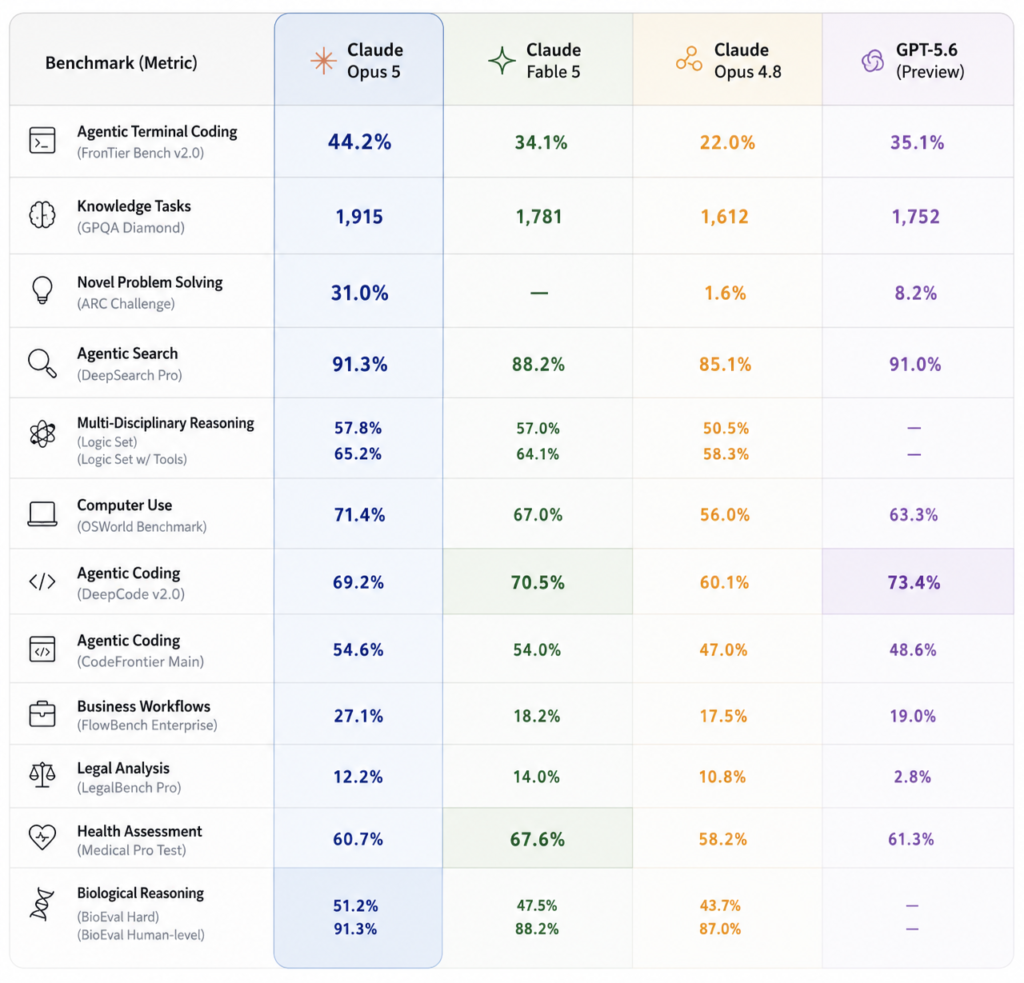
Anthropic is pitching Opus 5 not as its smartest model overall — that title still belongs to Fable 5 — but as the model built for the bulk of day-to-day work, where strong reasoning at a lower cost matters more than squeezing out the last few points of raw intelligence. The company says Opus 5 outperformed its predecessor, Opus 4.8, across the majority of its internal coding and knowledge-work benchmarks, including tests that combine tasks in physics, chemistry, and cryptography, all while keeping token pricing unchanged.
Stronger at Coding and Scientific Research
Anthropic describes Opus 5 as its most capable generally available model yet for scientific and life-sciences work, pointing to gains in predicting how mutations in a protein’s sequence might alter its function — a task with direct relevance to drug discovery and biological research. The company also says the model brings a meaningful jump in complex, agentic coding work compared with Opus 4.8, and that it can verify its own output and recover from mistakes with less human intervention than earlier models required.
A More Aligned, Less Deceptive Model
Anthropic is positioning Opus 5 as its most trustworthy release to date, reporting that internal safety evaluations found the lowest rate of deceptive behavior of any Claude model so far, along with reduced susceptibility to manipulation or prompt-based tricks. The company says the model adheres more closely to its published constitution governing acceptable behavior. On offensive cybersecurity tasks, Anthropic says Opus 5 was deliberately not trained for exploit development and remains substantially behind Mythos 5, the restricted model currently available only to select organizations through Anthropic’s Project Glasswing. Any cybersecurity gains in Opus 5, the company says, are a side effect of broader capability improvements rather than targeted training — enough to make the model useful for spotting vulnerabilities, without the same offensive edge.
Fewer Guardrails for Everyday Use
One recurring complaint about Fable 5, Anthropic acknowledged, was that its safety system would sometimes reroute prompts on sensitive-sounding topics to the older, more restricted Opus 4.8 rather than answering directly. With Opus 5, the company says it has recalibrated those classifiers to intervene roughly 85% less often, while keeping tighter limits in place for a narrow set of higher-risk cyber-related tasks. Notably, Opus 5 is not part of the 30-day data retention policy that Anthropic introduced alongside Fable 5 and Mythos, meaning usage data is handled the same way it was for prior Opus releases.
New Controls Over Speed, Cost, and Depth
Opus 5 also introduces adjustable “effort” settings, letting users and developers dial reasoning depth up for harder problems or down for faster, more token-efficient answers — a way to manage AI spending without switching models entirely. Anthropic also added the ability to swap tools mid-conversation without breaking the prompt cache, plus an option to automatically reroute flagged requests to another model instead of blocking them outright.
Pricing and Where to Get It
Claude Opus 5 is priced at $5 per million input tokens and $25 per million output tokens — identical to Opus 4.8 and available across all of Anthropic’s paid subscription tiers. It is now the default model on the Claude Max plan and the most capable option available to Claude Pro subscribers. Developers can call it through the Claude API as claude-opus-5, as well as through Amazon Bedrock, Google Cloud, and Microsoft Foundry, with availability inside developer tools such as GitHub Copilot.
A Crowded, Fast-Moving Market
The launch lands as competition intensifies on price as much as raw capability. Chinese AI lab Moonshot AI recently released Kimi K3, pricing output tokens at around $15 per million and drawing comparisons to Anthropic’s higher-end models on select benchmarks. OpenAI, meanwhile, shipped its GPT-5.6 model family earlier this month. The pressure comes at a pivotal moment for Anthropic, which filed confidential paperwork in June for a planned initial public offering later this year — a race in which OpenAI is also said to be preparing, though its own IPO timeline may slip into 2027.














Leave a Reply