

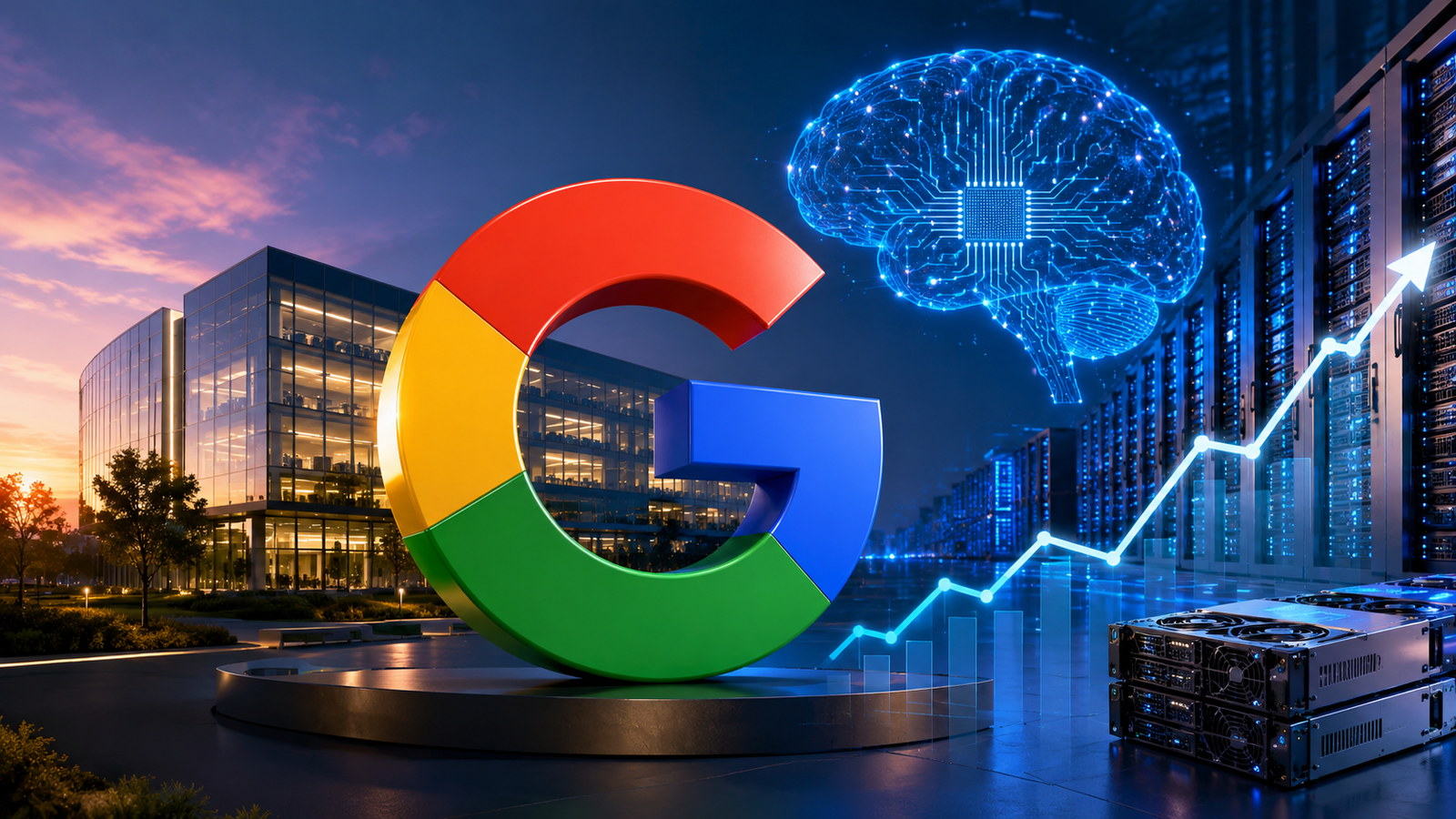
Alphabet posts its first-ever negative quarterly free cash flow as AI infrastructure spending hits record levels, even as revenue and profit soar.
Alphabet Inc., the parent company of Google, reported negative free cash flow for the first time since going public in 2004, as an aggressive buildout of artificial intelligence infrastructure pushed spending to unprecedented levels in the second quarter of 2026.
Free Cash Flow Turns Negative for the First Time
Google posted a negative free cash flow of $5.9 billion for the April-June quarter, a sharp reversal driven by soaring investment in data centers, AI chips, and computing infrastructure. Operating cash flow came in at $39.1 billion, but capital expenditures of $44.9 billion outpaced it, pushing the closely watched cash metric into negative territory for the first time in the company’s history as a publicly traded firm.
Free cash flow measures the cash a company generates from operations after accounting for capital spending. It has long been viewed by investors as a marker of Alphabet’s financial strength, making this quarter’s shortfall a significant moment for the stock.
Capital Spending Guidance Raised to $205 Billion
Alphabet also raised its full-year 2026 capital expenditure guidance to a range of $195 billion to $205 billion, up from its earlier forecast of $180 billion to $190 billion. It is the second time this year the company has increased its AI infrastructure spending target, underlining how quickly costs are escalating across the industry.
Chief Financial Officer Anat Ashkenazi told investors on the earnings call that free cash flow is likely to stay under pressure as the company continues investing to capture AI-driven growth opportunities. Management also indicated that capital spending is expected to rise significantly again in 2027, with the bulk of the money going toward technical infrastructure such as servers and data centers.
To help fund the buildout, Alphabet raised roughly $49.6 billion through an equity offering earlier this year, with proceeds earmarked for scaling AI infrastructure and global compute capacity — a sign of how capital-intensive the AI race has become even for a company as cash-generative as Google.
Revenue and Profit Still Climbing Strongly
Despite the cash flow strain, Alphabet’s core businesses kept growing at a rapid pace. Total revenue rose to $120 billion, up from $96.4 billion a year earlier — a roughly 24 percent increase. Google Cloud was the standout performer, with revenue jumping 82 percent year-over-year to $24.8 billion, while its operating margin more than tripled to 35.6 percent. Cloud’s backlog of signed contracts also grew by over $50 billion in the quarter to reach $514 billion.
Search advertising revenue rose 17 percent to $63.3 billion, though network advertising revenue slipped 1 percent, pointing to uneven trends within Google’s broader ad business.
Net income reached $112 billion, lifted in part by unrealized gains on Alphabet’s investment portfolio, including its stake in SpaceX. Operating income climbed 30 percent to $40.8 billion. Reported earnings per share of $9.11 beat headline estimates, but a large portion of that came from investment gains rather than core operations; adjusted earnings of $2.85 per share came in slightly below the $2.89 analysts had expected.
Pichai Points to Gemini 4 and Faster AI Releases
Chief Executive Officer Sundar Pichai said Alphabet has grown increasingly confident in its AI opportunities over the past year and is accelerating work on its next-generation Gemini 4 model. He said the pace of the company’s AI model releases would continue to pick up going forward. Executives also acknowledged that supply constraints in AI infrastructure could limit growth in the near term, and that Gemini still needs improvement in coding capabilities.
Alphabet’s “Other Bets” division, which includes ventures like Waymo, posted an operating loss of $1.8 billion for the quarter.
Wall Street Reacts to the AI Spending Surge
Alphabet shares fell more than 6 percent in early trading following the results, as investors weighed record capital spending against otherwise strong financial performance. Over the trailing twelve months, Alphabet’s capital expenditure has totaled $132.4 billion, a 98 percent jump from the prior year.
Google is racing against rivals Microsoft, Amazon, and Meta to build out AI infrastructure. Microsoft’s 2026 capital spending is tracking toward roughly $190 billion, while Meta has guided to $125 billion to $145 billion. Together, the four hyperscalers are expected to spend more than $725 billion on AI infrastructure in 2026, underscoring the scale of investment reshaping the technology industry.









Leave a Reply