

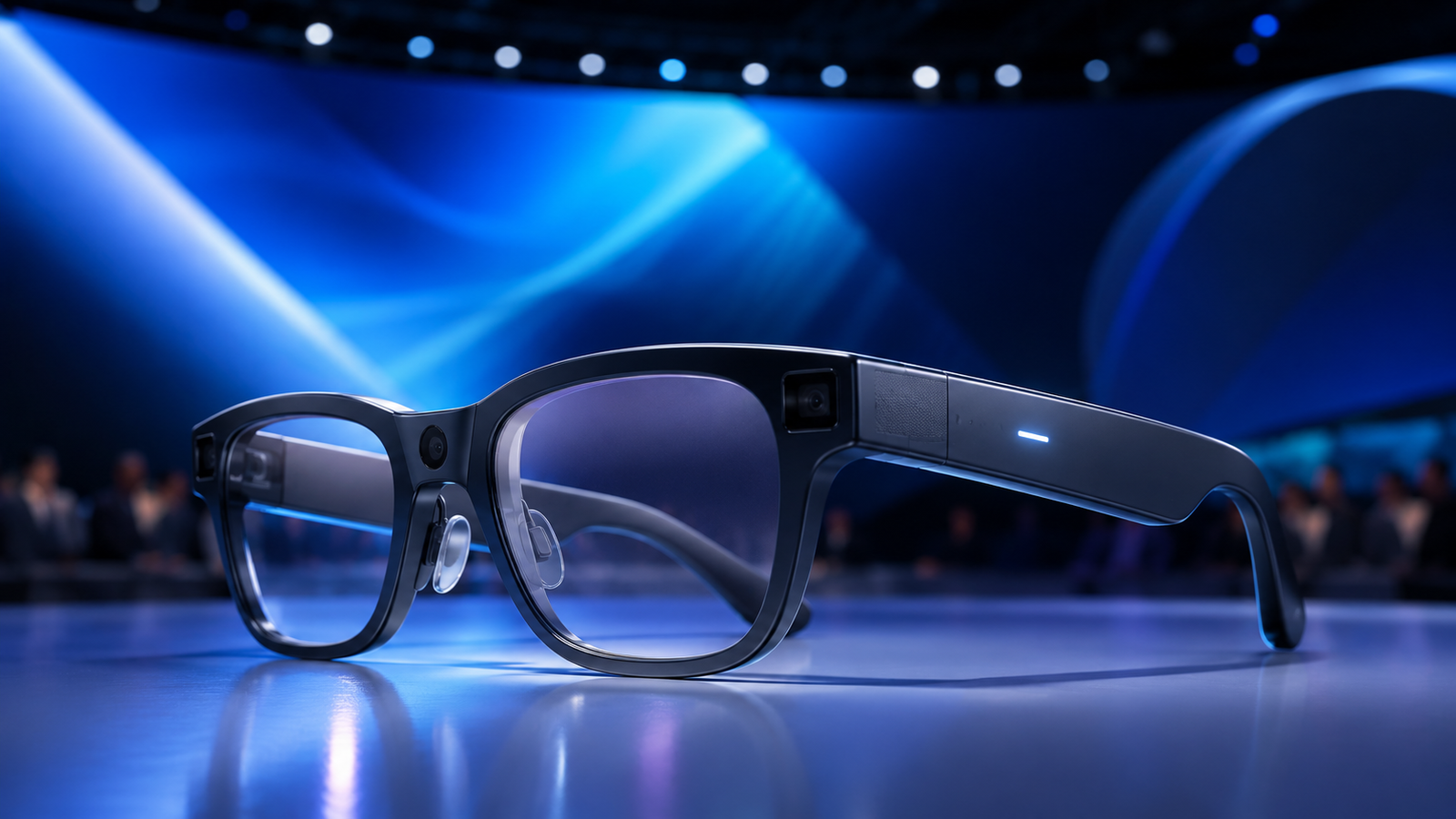
Samsung has officially entered the smart glasses market. The company unveiled its first AI-powered eyewear on July 22, 2026, at the Galaxy Unpacked event in London, built on Google’s Android XR platform with Gemini AI running the show.
The glasses are Samsung’s second Android XR device, following the Galaxy XR headset introduced last year. But where Galaxy XR targets gaming and professional mixed-reality work, this new eyewear is designed for everyday wear. Samsung developed the underlying platform with Google and Qualcomm, and partnered with eyewear brands Gentle Monster and Warby Parker on the physical designs. The reveal builds on a joint vision Samsung and Google first previewed at Google I/O 2026.
Samsung’s own materials describe the line simply as “Intelligent Eyewear,” though pre-launch reports had circulated the nickname Galaxy Glasses, along with an internal codename, Jinju.
Built on Android XR and Snapdragon AR1 Gen 1
Powering the glasses is Qualcomm’s Snapdragon AR1 Gen 1, a chipset built specifically for thin, lightweight smart eyewear rather than heavier mixed-reality hardware. That’s a step down from the Snapdragon XR2+ Gen 2 chip inside the Galaxy XR headset, which handles more demanding, power-hungry mixed-reality tasks.
The tradeoff is intentional: a lighter chip allows a slimmer frame that can pass for ordinary glasses. Samsung says the eyewear runs for up to nine hours per charge, and the included charging case can top it up roughly seven more times before it needs a wall outlet.
Two Frame Designs for All-Day Wear
Samsung showed off two looks at Unpacked. Gentle Monster’s version leans fashion-forward, with a slim black frame and a straight upper rim. Warby Parker’s take is more classic, using a warm brown frame with a slightly upswept brow line. Samsung said both designs went through repeated fit adjustments around the ears and forehead, since all-day comfort was a core design goal.
How Gemini AI and Bixby Handle the Assistance
Rather than build a new assistant from scratch, Samsung is leaning on Google. A version of Gemini built specifically for wearables handles most of the AI workload, with Samsung’s own Bixby assistant also contributing voice responses in some cases.
The built-in camera is what makes this more than a voice assistant in your ear: it gives Gemini a live look at whatever the wearer is looking at. Samsung’s example at Unpacked involved pointing the glasses at a whiteboard and letting Gemini capture the writing and organize it automatically into the Notes app. The same camera doubles as a way to record first-person video or share a live point-of-view feed during video calls.
Key AI Features at a Glance
- Message summaries: Long messages get condensed and read aloud, rather than requiring a screen.
- Real-time translation: Aimed at travelers navigating places where they don’t speak the local language.
- Navigation and local context: Turn-by-turn directions and nearby points of interest, delivered by voice.
- Hands-free controls: A mix of voice commands, touch-sensitive temple panels, hand gestures, and input from connected devices like a phone or watch.
No Display, By Design
There’s no screen anywhere on these glasses — no lens overlay, no floating text, no arrows pointing the way. Every interaction runs through audio and voice instead.
Samsung frames this as deliberate, not a limitation. The stated goal is AI help that doesn’t require staring at a screen, keeping the wearer’s attention on the world in front of them rather than a display. A screen-equipped version is reportedly already in development, but that’s a separate, later project, not this release.
The always-on camera raises some of the same privacy questions Meta has faced with its Ray-Ban lineup. Samsung representatives have acknowledged as much, noting that comfort with camera-equipped eyewear varies by country and culture, and that privacy safeguards remain an active area of work across the industry.
What Samsung and Google Executives Said
Won-Joon Choi, Chief Operating Officer of Samsung’s Mobile eXperience (MX) Business, tied the launch to a broader shift toward “agentic” AI — assistants that act on context instead of waiting for direct commands. In his framing, eyewear gives Samsung a new channel for that kind of assistance throughout the day, beyond what a phone screen allows.
Sameer Samat, President of Android Ecosystem at Google, described the project as a joint bet by the two companies: pairing frames people would actually want to wear with an assistant that reacts to what the wearer sees, rather than only what they type or say.
Speaking with CNBC after the event, Choi declined to confirm a price, calling the glasses a “premium” product that will be sold through Gentle Monster’s and Warby Parker’s own retail channels rather than Samsung’s stores alone.
Pricing, Availability, and the Competitive Landscape
Samsung hasn’t confirmed a price or an exact ship date. The company’s own materials point only to a fall 2026 launch in select markets. A $379–$499 price range has circulated in reports since spring, but that figure remains unconfirmed by Samsung.
The launch puts Samsung up against a market Meta has controlled since 2021. According to IDC, Meta held roughly 69.2% of the global smart glasses market in the first quarter of 2026, with a lineup spanning a $299 entry-level model up through the $799 Ray-Ban Display glasses. Apple is reportedly working on its own smart glasses too, internally called N50, but Bloomberg’s Mark Gurman has reported that project slipping from a late-2026 target to late 2027 — handing Samsung and Google a head start over Apple, even as both play catch-up to Meta’s lead.
Samsung is also said to be developing a second-generation model with a built-in micro-LED display, sometimes referenced under the codename Haean, targeting a 2027 launch at a higher price tier. Separately, Google is developing its own display-equipped Android XR glasses, with a trusted-tester program reportedly starting later in 2026.











Leave a Reply