

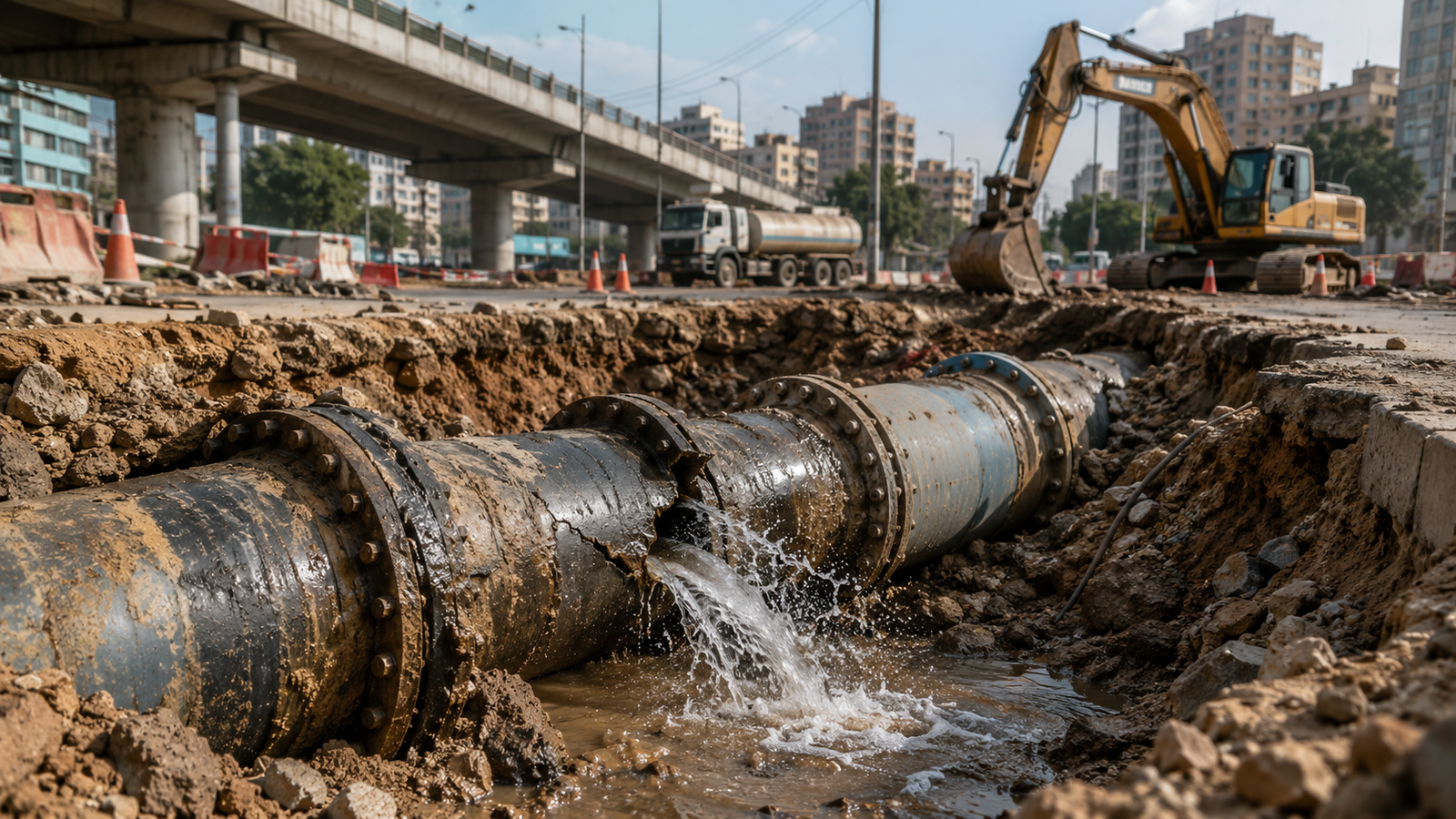
KARACHI: A damaged water pipeline near Nipa Chowrangi has left several parts of Karachi without a dependable water supply for five months, as the two authorities responsible for the city’s water network continue to disagree over who should pay to fix it.
The 33-inch pipeline runs beneath the Nipa Chowrangi flyover and was damaged during construction work on the K-IV project, a long-running scheme to expand Karachi’s water supply. Temporary repairs were carried out soon after the damage occurred, but officials say a roughly 200-foot stretch of the line was too badly damaged to patch up for good and now needs to be replaced entirely.
Five months later, that replacement still hasn’t happened. The Karachi Water and Sewerage Corporation (KWSC), which runs the city’s day-to-day water network, and the Karachi Water and Sewerage Services Improvement Project (KWSSIP), which is building K-IV, have each stopped short of accepting responsibility for the repair. With neither agency taking ownership of the work, the damaged section remains untouched, and residents in the affected areas continue to face shortages.
At a Glance
- Location: Nipa Chowrangi, beneath the flyover, Karachi
- Pipeline size: 33 inches in diameter
- Damaged section: Approximately 200 feet
- Cause: Damaged during K-IV augmentation works
- Duration: Unresolved for five months
- Dispute: KWSC and KWSSIP both decline responsibility for replacement
- Areas affected: Gulshan-e-Iqbal and nearby localities
How the Pipeline Was Damaged
The pipeline sits along a stretch of the University Road corridor, where K-IV crews have been laying new transmission lines between Nipa Chowrangi and Hasan Square. The project shares this corridor with the Bus Rapid Transit (BRT) Red Line, and the area has seen repeated utility disruptions as work on the two projects overlaps.
Residents got an early sign of how serious the damage was earlier this year, when the same 33-inch line ruptured and left several blocks of Gulshan-e-Iqbal without water for 11 days straight. Supply was briefly restored after repairs, only for the pipeline to burst again once water was released at full pressure — a failure sources at the time linked to substandard repair work. That episode appears to be why authorities are now insisting on a full replacement rather than another round of patchwork fixes.
Why KWSC and KWSSIP Can’t Agree
The delay appears to come down to a jurisdictional question. KWSC ordinarily maintains and repairs the city’s existing water lines, while KWSSIP is responsible for building the new K-IV infrastructure. Because the damage occurred at the point where an old distribution line meets a new project’s construction zone, neither agency has stepped forward to cover the cost of a full replacement.
No timeline has been announced for when, or how, the impasse will be resolved.
Impact on Residents
For residents of Gulshan-e-Iqbal and surrounding areas, the standoff has meant months of unreliable water supply. Many households have had to rely on private water tankers, often at considerable extra cost, just to meet daily needs. Frustration boiled over earlier this year, with residents petitioning Sindh’s chief minister, the provincial local government department, and Karachi’s mayor’s office for help — though the underlying dispute over the damaged section remains unresolved.
The K-IV Project: The Bigger Picture
K-IV was first launched in 2016 as a Sindh government initiative to bring an additional 260 million gallons of water a day (MGD) into Karachi’s network, financed in part through World Bank and Asian Infrastructure Investment Bank (AIIB) funding under KWSSIP’s second phase. The augmentation component alone — the 2.7-kilometre transmission line and connecting mains between Nipa and Hasan Square — is budgeted at more than $250 million.
The wider project has faced years of criticism over design changes, delays and rising costs since it was first announced. Speaking to a Senate committee earlier this year, KWSC Chief Operating Officer Asadullah Khan said Karachi currently receives about 600 MGD from the Indus River and another 500 MGD from the Hub Canal, against a citywide requirement of roughly 1,200 MGD — a gap officials say K-IV is meant to help close once it is fully operational.
For now, though, a project designed to secure Karachi’s water future has become the source of one more disruption to it, with a 200-foot gap beneath the Nipa Chowrangi flyover still waiting to be fixed.









Leave a Reply