

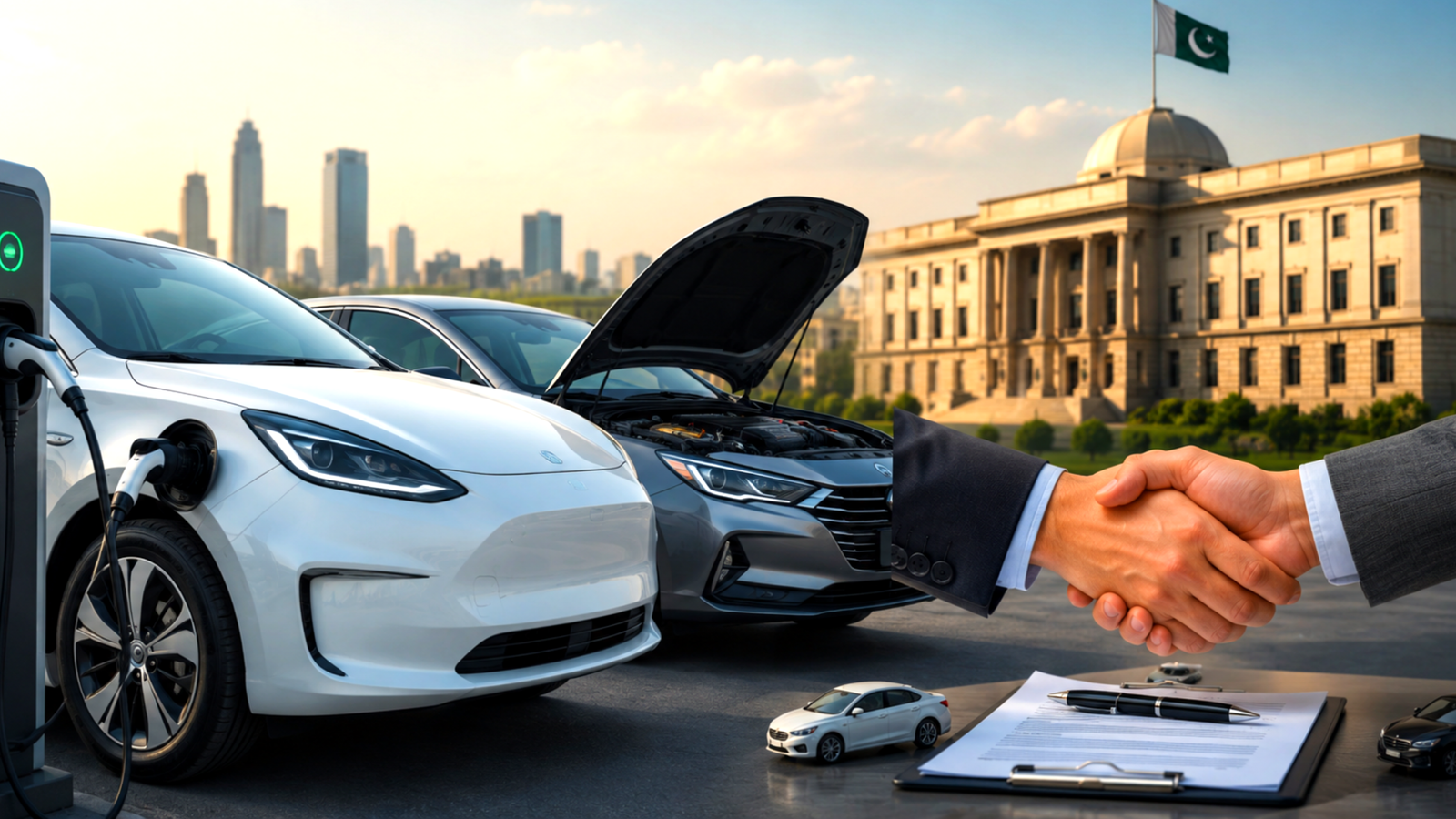
ISLAMABAD — Pakistan’s government has shelved its draft policy to accelerate the country’s shift toward electric vehicles, after local carmakers and auto-parts manufacturers convinced Prime Minister Shehbaz Sharif that the plan unfairly favored EVs over the hybrid and petrol-powered vehicles most Pakistanis currently buy.
The Ministry of Industries and Production had spent months preparing the new Auto Industry Development and Export Policy 2026-31, built around fast-tracking electric vehicle adoption to reduce the country’s fuel import bill. After manufacturers took their objections directly to the prime minister in recent days, the draft was withdrawn. Sharif has tasked Deputy Prime Minister Ishaq Dar with leading a new committee to rewrite the policy, according to sources cited in Pakistani media reports.
The reversal leaves Pakistan without a functioning auto policy at a moment when the previous framework, the Auto Industry Development and Export Policy 2021-26, has already expired — a gap that has triggered an automatic tax increase and pushed up hybrid car prices across the market.
Why Automakers Pushed Back
Industry representatives, led by the Pakistan Association of Automotive Parts & Accessories Manufacturers (PAAPAM), have said their objection was never to electric vehicles themselves. Their concern was the structure of the incentives: the draft policy, they argued, gave EVs a significant tax advantage without requiring those vehicles to carry any meaningful share of local content.
PAAPAM has cautioned that, without firm localization requirements attached to the incentives, the policy risked turning Pakistan into little more than an assembly point for imported EV kits — putting existing manufacturing investment and jobs at risk rather than building up a domestic supply chain. The association says it supports a shift to electric mobility but argues it should happen gradually, with EV tax breaks linked to rising annual localization targets covering batteries, electric motors and power electronics.
The group has also asked the government to help existing parts vendors retool their factories for EV component production, to give currently operating manufacturers an equal chance to introduce their own EV and hybrid models, and to protect companies that still rely mainly on imported components and basic assembly. Local carmakers raised these concerns with Sharif directly, prompting the review that led to the draft’s withdrawal.
Hybrid Buyers Already Paying More
The delay carries a real cost for consumers. Because the new Auto Policy 2026-31 was not notified before the old 2021-26 policy expired on June 30, 2026, the reduced sales tax rates that applied to hybrid vehicles lapsed automatically. Hybrid electric vehicles (HEVs) with engines up to 1,800cc had been taxed at 8.5%, and those above 1,800cc at 12.75%; both categories reverted to the standard 25% General Sales Tax from July 1, 2026, under rules enforced by the Federal Board of Revenue.
Automakers began passing the increase on almost immediately. Indus Motor Company, which assembles Toyota vehicles locally, raised prices on its two Corolla Cross Hybrid variants by Rs 1.364 million and Rs 1.314 million, taking them to Rs 10.299 million and Rs 9.849 million, respectively. Honda Atlas Cars Pakistan raised the price of its HR-V e:HEV by roughly Rs 1.37 million, to just over Rs 10.3 million. Other brands sold in Pakistan, including Hyundai, Kia, Haval, MG, Jaecoo and GWM, have seen or are expected to see comparable increases, with dealers citing hikes ranging from roughly Rs 1 million to more than Rs 2.5 million depending on the model.
Some manufacturers have temporarily paused invoicing and delivery of hybrid vehicles altogether, citing uncertainty over whether the government might still grant relief once the new policy is finalized. Dealers have warned that the sharp price jump could dampen demand in what had been one of Pakistan’s fastest-growing vehicle segments, and have argued the increase works against the government’s own stated goal of encouraging fuel-efficient transport.
Buyers currently shopping for a hybrid should expect list prices to stay at their post-July 1 levels for now, and should confirm current pricing and delivery timelines directly with dealers, since some bookings remain on hold pending regulatory clarity.
A Draft Two Years in the Making
The now-shelved policy was first outlined earlier this year as officials sought to reduce Pakistan’s dependence on imported fuel. Pakistan imports roughly 80% of the petroleum products it consumes, a dependence that came under fresh scrutiny after the US-Iran war disrupted global oil markets earlier in 2026 and pushed up crude prices worldwide.
Dar had already been reviewing the sector before the latest dispute. In early June, he chaired a high-level meeting on the auto and auto-parts policy that led to the formation of a subcommittee tasked with consulting stakeholders on the draft. At that meeting, Dar said Pakistan needed a competitive and sustainable automotive ecosystem that could support economic growth, expand industrial capacity, create skilled jobs and help meet the country’s climate commitments — goals officials have continued to cite even as the specifics of the policy remain unresolved.
That consultation process continued for weeks, with the draft eventually defining a new “New Energy Vehicles” category covering battery EVs, plug-in hybrids, range-extender EVs and fuel-cell vehicles. Under one version of the draft, plug-in hybrids and range-extender EVs would have seen their sales tax cut to as low as 1%, from 8.5%, effectively matching the treatment given to fully electric models. For consumers, the practical effect would have been stark: a locally assembled plug-in hybrid from a newer entrant could have ended up meaningfully cheaper than a conventional hybrid from an established brand such as Toyota or Honda, despite carrying a larger, more expensive battery. Established assemblers say that gap, more than the shift toward EVs in general, is what prompted them to seek the draft’s withdrawal.
What Happens Next
No timeline has been announced for when the Dar-led committee will produce a revised draft. In the meantime, industry groups are pushing for interim relief on the hybrid tax rate rather than waiting for the full policy to be finalized. According to Business Recorder, a proposal to set hybrid GST at 18% — below the current 25% but above the old 8.5% rate — has already been forwarded to the Finance Division and requires federal cabinet approval before it can take effect.
PAAPAM has framed the 18% rate as a bridge measure that would hold until Pakistan’s EV charging network and local parts industry are more developed. Whether the cabinet takes up that proposal before the broader policy is rewritten remains unclear.
Automakers that have already committed to electrified lineups are watching closely for how the revised policy treats their existing and upcoming models; industry estimates suggest a large share of the roughly two dozen new vehicle models expected in Pakistan this year use electric, hybrid or range-extended powertrains. The next concrete signal is likely to come either from a cabinet decision on interim GST relief or from the first outline of the redrafted policy, neither of which has been scheduled publicly.



Leave a Reply